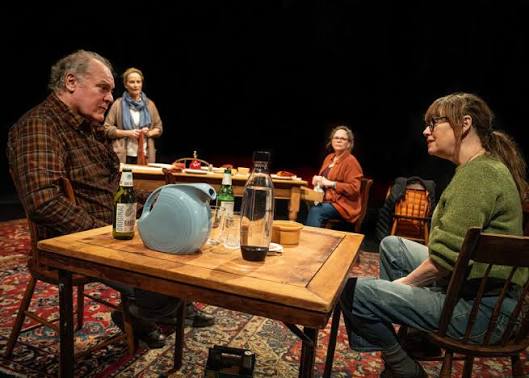
(Jay O. Sanders, Laila Robins, Maryann Plunkett, and Sally Murphy in We’ll See. Photo by Joan Marcus)
Each November means a trip to New York for the annual conference of the American Theater/Journalists Association in New York City, There I have the honor of helping organize, host, and attend panels featuring a wide range of people who make theater happen. This year’s weekend included insight from New Vaudeville icon Bill Irwin, playwright/actor/director Ruben Santiago-Hudson, and Broadway Bound podcaster Rob W. Schneider. There were sessions with the creatives from off-Broadway’s “The Heart” and “Waiting for Lefty” along with a panel featuring swings, understudies and standbys and another with leading casting directors. Plus we had the pleasure of seeing three actors have their work transformed in an audition workshop. The hits just kept on coming.
In and around the official conference events, I, like most of my colleagues, attended as many shows as we could pack into our schedules. Here’s are some thoughts on those I witnessed.
Godspell.
Since I was invited to a tech rehearsal of this Northeastern University student production, I won’t share details. Suffice it to say that I have a deep fondness for this show, even as a non-believer, and if I go a few years without seeing a production of it, I get hungry for one. I’m glad I caught this one.
Schmigadoon!
2026’s Tony Award winner for Best Musical contained few surprises for anyone who caught season one of the TV series. It did, however, contain many delights, including relentlessly upbeat dancing, genuinely funny lyrics, a few great gags that seemed sometimes to go over the matinee audience’s heads. I got a particular kick out of the reappearance of rapscallion Danny Bailey (understudy Zachary Downer) at the end. A deep bench of supporting players — including Jennifer Simard, Ann Harada, and Brad Oscar — aren’t given a whole lot to do, but they’re presence elevates their small-ish parts.
And while there’s related merch, also there’s no actual corn puddin’ available in the lobby.
Here There Are Blueberries
I’ve heard the word “clinical” used more than once when describing this play Moisés Kaufman and Amanda Gronich devised with members of the Tectonic Theater Project. But I’m going to push back on that. While it certainly does not follow conventional theater rules — at least, not for Broadway fare — it’s nonetheless a riveting piece of theater.
And, yes, it’s educational. I’m not sure why some see that as a problem.
The play, derived from first-hand accounts of those involved, is structured as a mystery. A photo album arrives at the United States Holocaust Museum. It contains images taken at Auschwitz, none of which show the victims. Instead, they show leaders, staff and families in a way that would seem pleasant and warm — if not for the uniforms and the knowledge we have of what’s happening beyond the walls.
Early on, I thought I’d be seeing the theatrical equivalent of the film “Zone of Interest,” the 2023 film about ordinariness of domestic life around the concentration camps. While that is captured in the photographs — which are creatively projected on stage with elements sometimes revealingly isolated — there’s more here than just the horror of the ordinary. There’s also a compelling curatorial procedural as the museum staff attempts to figure out who is in the images and what they reveal about who knew what when.
The cast contains an impressive lineup of theatrical notables, including Michael Cerveris (“Fun Home,” “Titanic”), Kathleen Chalfont (“Angels in America’) and Montego Glover (“Memphis”), all of whom disappear into the material, never pushing and, mercifully, never getting a “star” moment. There’s is selfless acting and adds to the power of the play. Less organic and more “I’m acting!” is Delia Cunningham as Rebecca Erbelding, the researcher who initially advocates for the project and serves as the prime communicator with the audience. My one complaint is that here style doesn’t match the tone of the show and the work of her fellows.
“Here There Are Blueberries” doesn’t push for tears. Instead it does something riskier and, for me, more powerful. At once a smart look at the importance of museum research, it also asks us to look directly into the faces of real-life, attractive, joyful, blueberry eating folks — real individuals who figured out a way to live with their complacency in the murder of millions.
Wanted
Rare is the new musical not based on existing intellectual property. Rare, too, is a musical with a what’s-going-to-happen-next drive. Rare as well is a musical where I can honestly say that I haven’t seen anything quite like that before.
All those are true about “Wanted,” originally developed in regional theaters as “Gun and Powder” and arriving on Broadway in terrific, crowd-pleasing shape.
I attended knowing only that it concerned two sisters who, during Reconstruction, became outlaws. Loosely based on real-life siblings Mary and Martha Clarke, it’s been musicalized (and largely fictionalized) by composer Ross Baum and book writer/lyricist Angelica Chéri, the Clarke sister’s great-great niece — .
Motivated by the the unfair debt piled on their sharecropper mother, the sibs seize the opportunities of their light skin, pass for white, and hit the road for a life of scale-balancing crime. Complications arise when one of the sisters, Mary (Solea Pfeiffer) falls for a wealthy white man, causing a rift with sister Martha (Liisi LaFontaine). While some — well, at least, some critics — may find this a distraction from the desired yee-haw western the marketing seems to promise, I found it an interesting and surprising plot development. The fact that the couple is given a lovely duet further defied expectations.
Factor in a delightful duo of domestics (Aurelia Williams and Awa Sal Secka) who, at first, seem simply to be comic relief but grow richer and more rounded as the show goes on, a chorus of angels/ancestors bringing down the house individually and collectively, and a story we haven’t seen on stage before and the result, while perhaps not a show for the ages, deserves major kudos. “Wanted” is fresh, entertaining, rousing, and a show I’m looking forward to listening to once a cast recording is released.
There will be a cast recording, right? RIGHT?
The Curious Case of Benjamin Button
Fresh from success in London, the musical adaption of John Steinbeck’s odd tale of an gent born old and aging-backwards, anchored the fall season at The Public Theater.
On stage, it not only musicalizes Steinbeck’s simple, satiric short story, it moves it from Baltimore during the Civil War to a 20th’s century Cornish village, overstuffs it with would-be colorful townsfolk, and turns the newborn elder from a Pinocchio-like wiseacre into a meek Forrest Gump. The core conceit remains — wisely unexplained — but just about everything else has changed, with his courtship and marriage watered down and a series of tragedies added. “Suggested by” would be a better credit than “based on.”
Fidelity to source material, of course, isn’t a requisite to engaging theater. But I wouldn’t have even tracked down the story to read if the musical hadn’t felt overstuffed and its ample charms lessened by stretching the fairy tale concept. You could read Steinbeck’s tale easily in less than an hour. The play takes 2 1/2 hours (with intermission) to achieve lesser results. Attempting to pull tears with multiple deaths, taking Benjamin to the brink of suicide, and having a deus ex machina plot resolution weaken rather than enhance the plot
Andrew Durand, in the title role, effectively transforms from senior to childhood mostly via gait, expression and gesture. A vibrant Kelsee Kimmel brings life to Elowen, his beloved. She, like the rest of the ensemble, plays her own instruments. Those frequently moving musician actors — on, among others, upright bass, cello, accordion, and mandolin — are a wonder, even when lyrics get lost — a particular problem when pushing to give personality to the villagers.
I’m curious how it will all sound when a cast recording is made, which I hope happens. This is the highest-profile show, at least stateside, for the music/lyrics team of Darren Clark and Jethro Compton and the score left me curious to hear more.
We’ll See
Also at the Public, Richard Nelson’s latest Apple Family play, “We’ll See,” reunites Jay O. Sanders, Maryann Plunkett, Laila Robins, and Sally Murphy from previous works in the series, adding Yvonne Woods to the mix.
Since 2010, the fictional Apples have gathered around the table in Rhinebeck, New York, for food and conversation. The plays — this is the fifth, along with two virtual ones during the pandemic — aren’t packed with action. Each is set on the day the play actual opened — the first on the night of the 2010 midterm elections, this one on the brink of the 2026 midterms — and with each we hear discussions both political and personal.
The performances in “We’ll See” feel deeply lived in (this is the first I’ve seen live, the rest on pro-shot recordings) and it certainly helps to have seen the previous installments. Like the “Up” documentaries, which periodically revisited the same actual people from age 7 to 70, the Apple plays allow viewers to drop in on characters we’ve come to know, experiencing their reactions to the world and both the small and large changes in their lives. Unlike that film series, though, the Apple plays don’t allow clips from previous installments to enter into the mix, leaving it up to the new content to both serve the loyalists and stand on its own.
I was certainly satisfied by the chance to finally be in the room with the Apples. I can’t say whether the same can be said for newcomers. Regardless, though, anyone attending is privy to humanistic acting on a rare level.
The Verge
I wish I had more to say about the third play at the Public, created in a partnership with Fiasco Theatre.
There’s certainly academic interest in Susan Glaspell’s 1921 play, first staged by the storied Provincetown Players. But this once ground-breaking tale of an iconoclastic woman botanist (Miriam Silverman) pushing back against Victorian ideals — and eventually driven to madness — doesn’t come alive in director Jessie Austrian’s production. Various visitors — husband, friend, lover — enter and exit the handsome greenhouse set that proves too literal for the expressionistic wildness of the material.
We’re left with little except the chance to say we say a rarely produced Glaspell play.

