On a four day visit to the Stratford Festival in July, I was able to witness all but one of the simultaneously running productions, only missing “Othello” and a trio of plays not opening until August. None of the eight plays I attended should require even a cursory plot synopsis from anyone likely to visit this page.
Day one began with Samuel Beckett’s “Waiting for Godot,” directed by Molly Atkinson and given strong anchoring by Tom McCamus and Paul Gross as the duo in constant standby (making me wonder what kind of meta experience the understudies are experiencing).
This is the fourth time Stratford has offered the play but the first in my experience and I’m glad to report that the Festival Theatre, the largest venue here, did not swallow the intimate show. Quite the opposite: the multiple exits on stage and the voms off implied a vast world that accentuated the isolated nature of Vladimir and Estragon. The lone tree – emerging through a fractured stage – acknowledged the artificiality of the stage experience while not undermining the play itself.
Atkinson and her team embraced the humor of the piece, albeit with less emphasis on the physical and more on the verbal. That works, though, particularly given McCamus’ world-weary Estragon. His silences and his stares are often more powerful than lesser actors’ monologues.
The show’s focus dips a bit when Pozzo and Lucky arrive. Rather than waiting for Godot, I found myself waiting for those two to leave so that we could get back to the central pair.
The evening took a decidedly brighter tone with “The Importance of Being Earnest.” There are more witticisms per square inch here than just about anywhere and, in Krista Jackson’s production, nearly every one lands. Fiona Reid, as Lady Bracknell, gets the final curtain call – and she’s wonderful – but the play works when the entire cast understands the assignment fully. And this one does. Set designer Bretta Gerecke has rimmed the stage with dense flower beds that match the welcoming scrim. The pastel set and Cory Sincennes’ equally appealing costumes set a decidedly confectionary tone. If details or even the production’s existence are unlikely to be deeply remembered in seasons to come, well, that doesn’t diminish the pleasures had while it did much more than just shilly-shally on the Avon Theatre stage.
Day two offered a heavier double.
The matinee audience for “Death of a Salesman” was welcomed into the Avon by charming trumpeter Michael Louis Johnson. It seemed deliberately unclear whether he was playing a character or being himself as he tooted out “I’m Gonna Sit Right Down and Write Myself a Letter” and other tunes while chatting up the crowd and administering the land acknowledgement and cell-phone warnings.
His rendition of “Blue Skies” ironically led us into the play itself, led by yesterday’s Estragon, Tom McManus, as Willy Loman. As wrenching as Arthur Miller’s play is, it requires a cast that can make both clear and complex the forces that hold this family together while tearing it apart. It’s graced with stellar work by McManus with Stratford stalwart Lucy Peacock a strong match as Linda. As troubled sons Happy and Biff, Josh Johnston and Joe Perry make clear this is a show about a family, not just a man.
Director Dean Gabourie wisely not only incorporates the trumpeter throughout but allows him to provide a buffer between the play’s final moments and the obligatory curtain call. As such, the audience is granted valuable moments to digest before rising to its feet with applause.
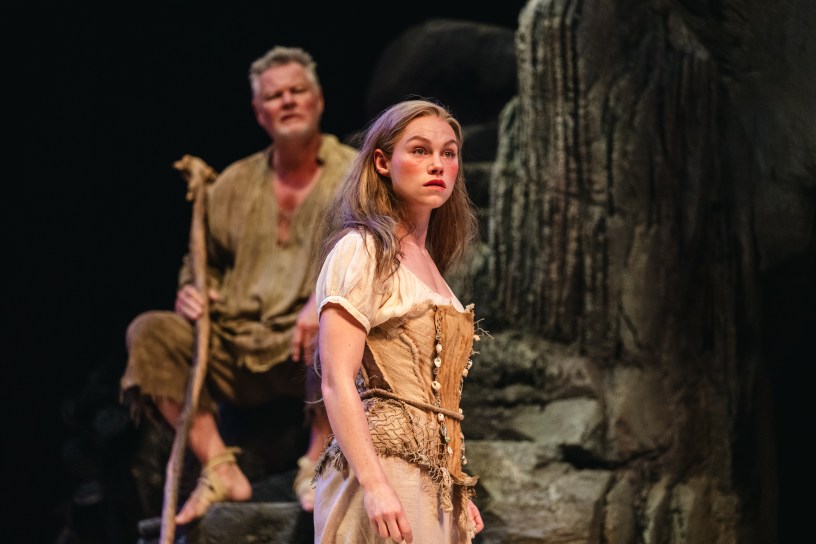
There’s complex parenting as well on stage in “The Tempest,” Antoni Cimolino’s farewell production as artistic director. It’s a bit cliche to round out a tenure with this particular play but it’s justified here, with Geraint Wyn Davies offering up a melancholy Prospero who seems more focused on the happiness of his daughter than revenge against those who wronged him.
It opens with a stunning storm orchestrated in fiction by Prospero and Marissa Orjalo’s spritely Ariel but in reality by set and costume designer Julie Fox and lighting designer Imogen Wilson.
Raising the stakes this early could make the rest of the journey a letdown but that’s not the case here. While Cimolino offers a calmed version of the play often produced in a more agenda-ed way, it’s never dull and often beautiful both visually (the giant jellyfish puppetry sequence is an elegant wonder) and narratively (Miranda offering Caliban a forgiving hug was a surprisingly lump-in-the-throat moment).
Day three offered a pair of musicals each revived from previous seasons and given Broadway level productions.
“Something Rotten!” proved the most successful of the two. Experiencing characters singing “God I Hate Shakespeare” in the midst of North America’s largest theater festival certainly gives it a meta-level. But the show that seemed to come out of nowhere to bring smiles to Broadway here proves to be a show well worth a place in the musical theater repertoire.
Donna Feore, Stratford’s master of musicals, directs and choreographs this one for maximum playfulness while keeping the stakes of the story at least reasonably important. Mark Urhe’s struggling play producer protagonist Nick Bottom and Henry Firmston’s poet brother Nigel make for a team to root for. Starr Domingue Olivia and Olivia Sinclair-Brisbane are in wonderful voice as Bea and Portia. Dan Chameroy gives a quirky take on Nostradamus. And Jeff Lillico is our slickly sinister Shakespeare. The icing on this delicious cake comes from Steve Ross as Shylock “the really nice Jew.” Ross’ work here never upstages while giving every line a delightful spin.
Ross is equally joyful, with more to do, as Nicely-Nicely Johnson in Guys and Dolls. His “Sit Down You’re Rocking the Boat” doesn’t copy the versions available in multiple recordings, instead bringing his own take while staying true to the character he’s built from the opening “Fugue for Tinhorns.”
So strong is Ross that I wished he and Gabriel Antonacci (Benny Southstreet) had taken the lead roles of Nathan and Sky over the miscast Mark Uhre and Dan Chameroy. More satisfying on the distaff side, Olivia Sinclair-Brisbane sparked in the Havana sequence and Jennifer Rider-Shaw took ownership of “Adelaide’s Lament.” As with “Rotten,” Feore’s choreography sparkled.
Day four paired two fantasies, “The Hobbit” and “A Midsummer Night’s Dream.”
The former, targeted to young audiences, featured a circular abstract and very functional set by Lorenzo Savoini that proved adaptable to various environments on the title creature’s journey. The adaptation by Kim Selody was clear and often amusing while never quite being able to shake the interchangeably episodic nature of the adventure. The Puppetry team, headed by Valeria Pugliese, pulled off an effective Smaug.
Developed in collaboration with Groundlings Theatre, “A Midsummer Night’s Dream,” directed by Graham Abbey, breathed knockabout life into the crowd-pleasing warhorse.
Here Titania’s entourage had a water nymph vibe, Puck had a teen mischievousness, and the changeling child had a more central role than usual. She’s key to an added prologue – something Stratford audiences should be accustomed to – that anchors the central conflict between Titania and Oberon while giving us a lovely thread to follow to a surprising and resonant end.
One of the challenges of the “Dream,” in any production, is keeping audiences from outright rejecting Demetrius when he’s ultimately paired with Helena. This one almost pulls it off, thanks to moments early on where it’s clear that he has feelings for her in spite of his pursuit of Hermia. Played with the youthful energy (read: horniness) that the roles desire, all four (Vivien Endicott-Douglas, Jessica B. Hill, Jordin Hall and Thomas Deuplessie) come vividly to life. And the laughs are plentiful.
Making the rude mechanicals a travelling circus troupe brought nothing to the table while undermining the importance point that they are rank amateurs. Nonetheless, they, too, brought the laughs as well as a few poignant moments. Plus a smile-inducing one when Robin Starveling (Michael Man) showed his piano-playing chops.
In all, a solid year for Stratford … a festival where hating Shakespeare is simply not an option.
The Stratford Festival runs through the end of October with some shows closing in late September. Visit Stratfordfestival.ca for specific dates and times.


