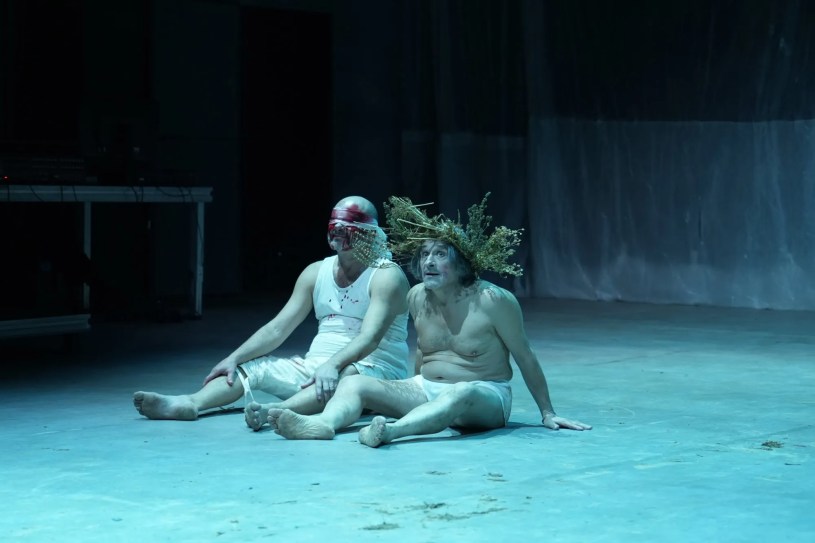
Some thoughts on recent theater experiences.
HERE:
Due to scheduling issues, I couldn’t get to Lynn Nottage’s “Clyde’s” until its final weekend at Fonseca Theatre. That, alas, kept me from encouraging folks to get to see the strongest combination of ensemble and design work I’ve yet experienced by the westside Indianapolis company. It helped, of course, that it’s also a strong play.
In it, formerly incarcerated folks work in a purgatory of a sandwich shop presided over by Clyde. If anyone else besides Nottage
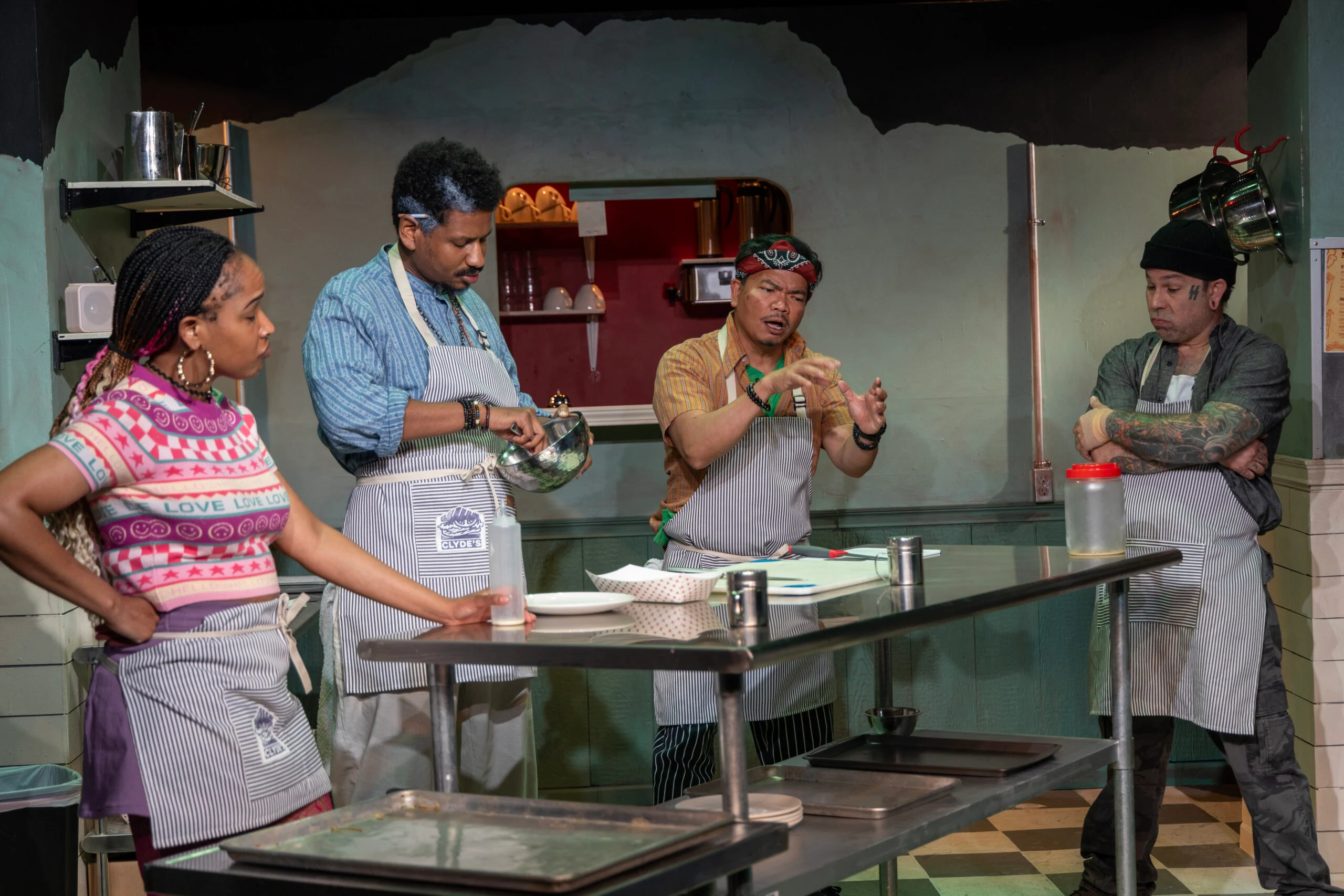
had written the play, she’d probably be a restaurateur with a heart of gold, eventually showing her a soft side. In Nottage’s world, though, she squelches creativity, calls her employees “morons,” and, when she says she “doesn’t do pity,” it’s not a wall that will be torn down. It’s her default. As played with often terrifying silence by Chandra Lynch, there’s never a doubt about the power she yields.
When Clyde isn’t in the kitchen, there’s bonding of sorts between the workers, especially when Montrellous (Jamaal McCray), a sort-of sandwich sage, speaks rhapsodically about ideal bread/veggie/meat/condiment combinations. This is when signs of hope appear like green shoots arising through concrete of their lives. And when newcomer Jason (Dave Pelsue), complete with white supremacist tattoos, is added to the kitchen mix, it would seem we have a new antagonist. Rather than an instigator, though, Jason proves fairly passive — which is particularly surprising if you recall the same character’s actions in Nottage’s earlier play, “Sweat.”
Nottage is more interested this time in character than plot, though. And the play becomes a unique charmer because of that. It’s not surprising why it has become one of the most-produced plays in regional theaters in the past few years.
There:
I had the honor of representing the U.S. as a delegate to the International Association of Theatre Critics congress in Craiova, Romania in late May. The fringe benefit of that was the chance to attend productions at the wildly ambitious and wide-ranging Craiova International Shakespeare Festival.
Of the four productions I witnessed, the most satisfying and consistently impressive was a homegrown “King Lear” anchored by a riveting Claudiu Bleon in the title role. With all audience members seated three quarters around the National Theatre stage, there was no escaping the intensity of the action (or the asshole in the front row who was scrolling on his phone during the climactic scene). So rich were the performances that I found myself only occasionally glancing at the unobtrusive projected English titles. With the storm downplayed and a greater emphasis on palace intrigue then Lear’s emotional arc, I can see purists being a bit put off but I appreciated the kinetic energy and up-close intensity it offered.
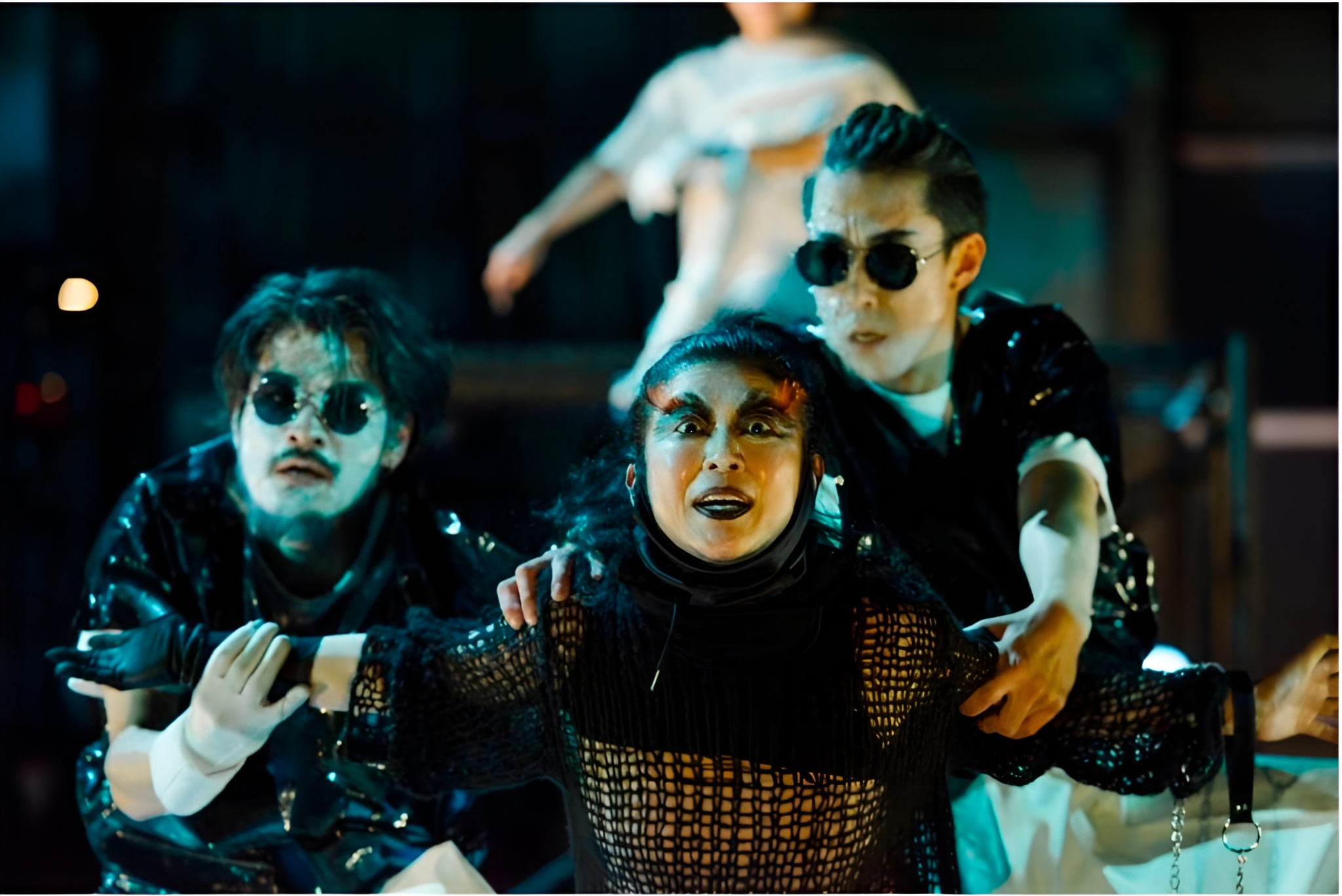
The most visually exciting of the work I saw was “Titus Andronicus Reborn,” from the Japanese company Kakushinhan. Even those unfamiliar with Shakespeare’s goriest work may realize early on that “reborn” here means recontextualizing, adding characters (including a young boy and a crow), incorporating traditional Japanese theater elements, and breaking the fourth wall (the strongest moment for me was a narrator confrontationally asking the audience why they would attend such a show). Although at 2 1/2 hours without intermission — compounded by an over 20-minute late start — I’d be lying if I didn’t say it was a rough sit. By the time Titus’ notorious dinner party arrived, I had mentally clocked out.
Less interesting was “II,” from Cape Town, South Africa-based Abrahamse & Meyer Productions. A fusion of Christopher Marlowe’s “Edward II” with Shakespeare’s “Richard II,” it did no favors to either. Instead, the two troubled kings engaged in a kind of therapy session with each other, exchanging passages from their plays mixed with original material that trivialized both. Without the context of each original, the drama was drained. Meanwhile, “Mercutio,” from Paris, France’s Collectif NOX, was more playful, mixing pop music and rap battling. Clever, at times, it nonetheless felt overly padded, as if the creators were trying to hide the fan fiction nature of the project.
That quartet of shows is just a small portion of what’s offered at the festival. In addition to a long list of additional full productions, the festival includes an outdoor Shakespeare village, free concerts, art exhibitions, lectures and more. If it was a few hours away instead of requiring a 24-hour three-plane journey, I’d happily return.
Everywhere:
The latest pro-shot theater production shared by PBS’ Great Performance series, “Top Hat,” is a trifle best half-watched while
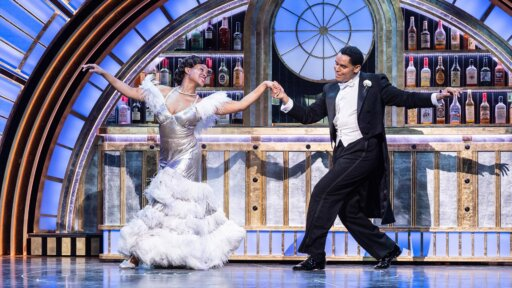
doing the dishes or otherwise taking care of house business. Based on the already light 1935 Fred Astaire/Ginger Rogers musical, the stage adaptation stretches is a full half hour longer than the film, leading to a case of get-on-with-it-ness, particularly during its mistaken identity plot machinations.
The gold standard for turning past-their-prime musicals with great songs into successful “new” stage shows is “Crazy for You,” which gave the Gershwin’s “Girl Crazy” a book overhaul, incorporated songs from other Gershwin shows, and gave hope to Broadway during the British invasion of the early 90s. More recently, stage adaptations of yesteryear movies with strong song stacks — including “White Christmas” and “Holiday Inn” — have reached the stage with mixed success. “Top Hat” is pleasant enough when toes are tapping and love songs delivered — the Irving Berlin hit list here includes “Puttin’ on the Ritz” and “Cheek to Cheek” — but there doesn’t seem to be a strong engine behind it or an upgraded book.
That’s no slight to leads Phillip Attmore and Amara Okereke or to director/choreographer Kathleen Marshall (who, surprisingly, hasn’t had a show on Broadway since 2017.)

