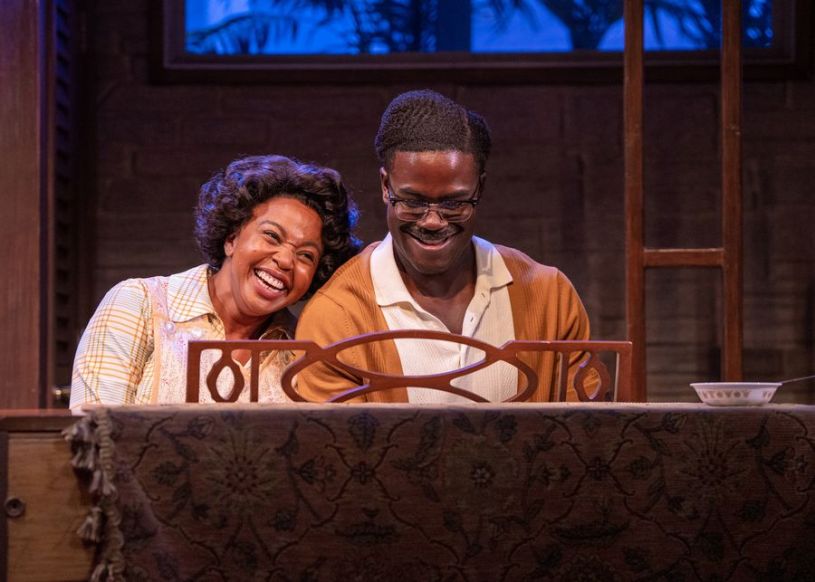
(Jerrika Hinton and Bradley Gibson in “Freemont Ave.” Photo by Scott Smeltzer)
Some thoughts on recent theater experiences.
HERE:
First up, Kate Hamill’s “Ms. Holmes & Mrs. Watson, Apt. #2B,” produced by Summit Performance Indianapolis at the Phoenix Theatre Cultural Center, where it runs through March 24.
A change for Summit, which usually tackles plays with more gravitas, “Ms. Holmes” is billed as “cheerfully desecrating the stories of Sir Arthur Conan Doyle.”
With plot elements borrowed from “A Study in Scarlet,” “A Scandal in Bohemia” and others from the Doyle bookshelf, “Ms. Holmes” is, at its core, a convoluted mystery without much in the way of stakes. That’s not a reason to dismiss it, of course. While such efforts have pretty much disappeared from Broadway — where shows such as “Deathtrap” and “Sleuth” were once reliable season anchors — regional theaters have demonstrated that mysteries, whether from Doyle, Agatha Christie, or those writing in homage, have proven to be audience pleasers. (For a while there, it looked like they owned a slot every year in the Indiana Repertory Theatre’s season.)
So perhaps I was expecting too much from Hamill’s play. Her relentlessly inventive 2016 off-Broadway “Sense and Sensibility,” contained wonders. But while the genders have been flipped and the time updated, there isn’t much “desecration” inherent in her “Ms. Holmes” script.
We still have a Sherlock (an intensely focused Frankie Jo Bolda), a grounded Watson prone to panic attacks (a delightfully dyspeptic Kelsey VanVoorst) and appearances by other characters familiar from the Holmes library (variously and ably played by Andrea Heiden and Clay Mabbitt). There’s a mystery to be solved, of course, with many a misdirect sprinkled in along the way. The difference between Mr. Holmes on paper and Ms. Holmes on stage here, though, has less to do with mythbusting or radical revisionism and more to do with the infusion of verbal and physical comedy. Some of it works here, some of it doesn’t, in spite of the valiant efforts of the cast. The pacing is often fast — perhaps too fast. And the play is at its best when it pays less attention to the convoluted mystery plot and more to its core characters. Laura Glover’s lighting certainly adds flavor. Ben Dobler’s sound design is on point. And Christian McKinney’s set has a smart combination of sparse and specific — I only wish frequent scene changes didn’t impact the play’s momentum.
THERE:
Earlier in May I paid my first visit to South Coast Repertory Theatre in Costa Mesa, California, for the 28th annual Pacific Playwrights Festival.
Impeccably organized and produced, the festival offers two mainstage world premiere productions as well as staged readings of five additional pieces.
A case of the sum of its parts being greater than the whole, Reggie D. White’s ambitious, multi-generational family drama, “Freemont Ave” featured three distinct acts (with one intermission).
The first, set in 1968, focused on the evolving relationship between a budding composer and the woman hired to clean his house. The second, anchored in the 1990s, picked up the story of their son/stepson. The third, now in the 2020s, dealt with the grandson’s issues. If I hadn’t consulted the program, I wouldn’t have realised that each generation featured a distinct character played by the same actor, Bradley Gibson.
A key element of the many-faceted play is the way a loving grandmother’s religious beliefs undermined a grandson’s sense of self. It’s a fascinating conflict that I have not seen on stage. The problem, though, is that I didn’t quite see it on stage here, either. We never see these two characters together. The third act is set at the time of her funeral so we only get reaction rather than action.
Nonetheless, there’s terrific character building here, wonderful dialogue, and a willingness to let the story breathe. All refreshing if not completely satisfying. I’m hoping more rewrites are on the way.
Where “Fremont Ave” was grounded realistically in a recognizable, realistic place, the other mainstage production at this year’s festival, Talene Monahon’s “Eat Me,” provided a dramatic contrast.
There’s a hunger for both food, connection and more from its characters, including Chris (Sheldon D. Brown) who, because of some unspecified accident, has impacted his relationship with food. In a restaurant on a first date, he orders an absurd amount of dishes even though there’s no way he and his potential partner could eat them all. And he spends much of his spare time on an online gourmet site (sonorously personified by Jeorge Bennett Watson). In his orbit are the date, Chris’ pregnant sister and her lover, an elderly roommate, and her cats, Eleanor Roosevelt and Coconut Joe.
The action jumps from one pool of light to another, time is jumped, the fourth wall disappears, and locations may or may not be as they appear. I’m good with a play being cryptic — but it has to give me reason to want to sort it out. This one left me … nah, I won’t say it. Too obvious.
Because they were readings of works still in progress, I won’t be writing about the five very well cast and directed play readings that rounded out the festival. Suffice it to say that I’m looking forward to the 2027 festival when two of this year’s presentations, Eleanor Burgess’ very funny meta-comedy “The Ingenue” and JuCoby Johnson’s drama of friends trying not to lose each other, “Three-headed Monster,” will be boosted to full mainstage world premiere productions.
I’m looking forward to returning — especially since I’m still mourning the loss of the Humana Festival of New American Plays, which used to be my go-to place each year to be washed over with new stage work.
EVERYWHERE:
Thanks to PBS’ Great Performances, you don’t have to time travel back to 2024 to see the original cast onstage in Shaina Taub’s musical “Suffs.” It’s now streaming on the network’s website.
It was an easy show to pass over during its Broadway run. How entertaining can a show be about the fight for the 19th amendment? One could say the same about “1776,” of course, but the debate and signing of the Declaration of Independence took place in a concentrated amount of time and largely in a single place. The right to vote for women lacked such unity of time, place and action.
Taub’s take on the subject emphasizes the range of strategies employed by those seeking Congressionally certified justice in the form of an amendment. At the center is Alice Paul, played by Taub as a can-do, keep-fighting scrapper who gives the kaleidoscopic story a solid core. Along the way there are encounters with a suffrage who’s who — smart women who didn’t always agree on how. Hence the drama.
Procedurals are tough for musicals, though, and “Suffs” doesn’t quite shake the “this show is good for you” stigma. That being said, I still found it both instructional and very moving. Taub is a unique performer — ernest and sympathetic while never being cloying. She creates a Paul that we root for — not just because what she is trying to achieve will be world-changing but also because we want her to succeed. That’s important in a show that doesn’t shy away from its double duty as an entertainment and a rallying cry. And Taub, as demonstrated in her musicalization of “Twelfth Night” and other works, knows how to craft varied songs that work on stage.
Even if, like me, you bypassed it on Broadway thinking it an extended Schoolhouse Rock, the inspirational “Suffs” is well worth a watch.
I’m glad PBS continues to offer pro-shot theater.
And I’m glad Taub keeps writing.

