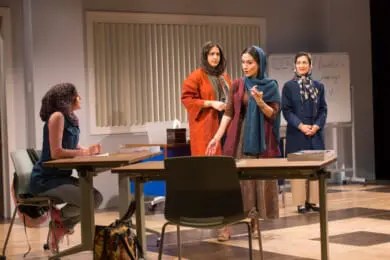
Sanaz Toossi’s Pulitzer Prize-winning play had its local premiere at Indiana Repertory Theatre (photo by Zach Rosing). Some thoughts.
– Before I get to the show itself, let’s talk about the Pulitzer. I believe that, when most people who actually think about such things think about award-winning plays, they think of the Tony Awards. While that program is certainly the highest profile – at least here in the states – it only considers productions that appeared in a very specific chunk of Manhattan in a set of very specific theaters. If it hasn’t played Broadway, it’s not eligible. Other New York theater awards – the Obies, the Drama Desk etc., — have wider views, but not views that extend beyond New York city limits. On the opposite side, the ATCA/Steinberg Awards – of which I am an active committee member – only considers plays that were produced outside of New York. Land an NYC production in the year you premiere elsewhere and your play is out of the running. The Pulitzers are that rare bird that includes it all, And while it hasn’t exercised the option since 2006, it has no trouble declaring “no award” in a year where nothing overly impresses its panel.
– All of which to say is that winning a Pulitzer is a big deal. And its record is very solid. It’s tough to argue with a roster that includes Lynn Nottage’s “Ruined,” Suzan-Lori Park’s “Topdog/Underdog,” David Auburn’s “Proof” (returning to Broadway this season in a new production), Tracy Letts’ “August: Osage County” (please don’t judge it by the crappy film version), and, more recently, “Hamilton,” “Cost of Living,” “Sweat” (All of which have been seen on Indy stages) and, in 2023, “English.”
– Set in Iran (talk about timing) in 2008 (effectively dodging challenging geopolitics), it focuses on a quartet of students who, for a variety of reasons, want and/or need to learn English. The conceit of the show – and one that the opening night audience seemed to grasp fairly quickly – is that when the characters are speaking in their native Farsi, what we hear is very clear American English. When they are speaking in English, we hear hesitant language, misstatements, struggling for words, and sometimes malaprops. These subtly lessen as the lessons go on, but there is some discomfort early on when many of the laughs felt oh-those-awakward-foreigners condescending.
– Then again, that may be part of playwright Toossi’s agenda. Yes, get the audience laughing at the awkwardness in the way they would have at a 1940s movie. But, in the end, once they’ve come to care about these characters, let them hear the beauty of the language and have a greater appreciation for the challenges of adapting. Through character development, thoughtful writing, and without lecturing, “English” offers cunning insight into what it means to one’s identity not to be as funny or insightful or as clearly brilliant as one is in one’s native language.
– The play is at its strongest when it reveals those struggles. It’s less impactful when it imposes plot, particularly a difficult-to-buy twist involving the lone male student and the teacher (although Revon Yousif and Neagheen Homaifar are both fine in the roles). The play soars, though, in many delicate moments. Leyla Modirzadeh digs deep as Roya, a woman trying to connect with her Americanized grandchildren. And the struggles seems completely real for Elham (Natasha Behnam) who can’t help but break the Only English classroom rule when she knows Farsi holds what she truly wants to say in the way she needs to say it.
— Think about it, the play insists, don’t we have enough trouble trying to articulate our thoughts and feelings in our native language? Imagine trying to do that while building a vocubulary and being hyper-aware that many who hear you will assume ignorance rather than try to understand the challenge.
— By the way, this decades other Pulitzer winners have been Michael R. Jackson’s “A Strange Loop,” Katori Hall’s “The Hot Wings King,” James Ijames “Fat Ham,” Eboni Booth’s “Primary Trust,” and Brandon Jacobs-Jenkins’ “Purpose.” I honestly believe that if Bryan Fonseca and the old Phoenix Theatre on St. Clair St. were still around, half of those would be part of his season. Here’s hoping for more as 2026-2027 lineups are announced around town.
–
 louharry.com