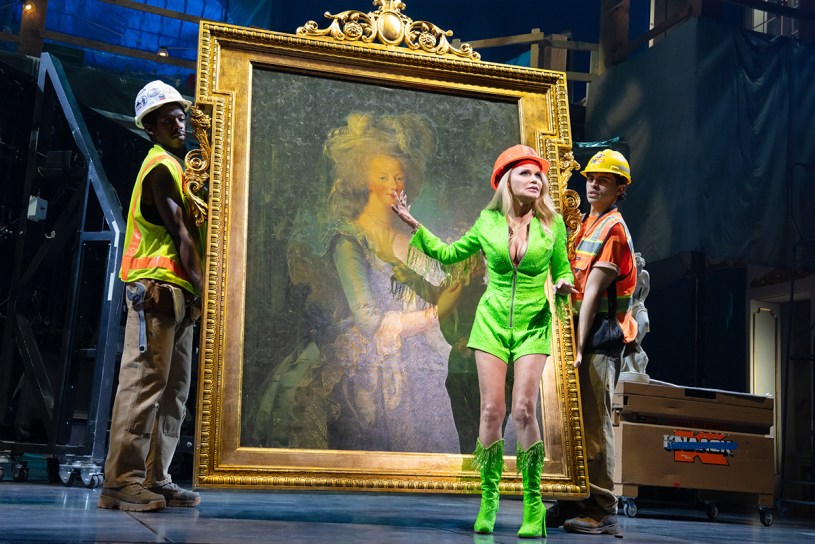
Based on a documentary, The Queen of Versailles, the new Stephen Schwartz and Lindsey Ferrentino musical on Broadway at the St. James Theatre concerns an amoral, in-it-for-herself character with no regard for the impact on others who allows her own ambitions to blind her to the needs of her children.
None of those elements are a deal breaker for satisfying theater.
It is entirely possible, for instance, to build a successful Broadway musical around an amoral in-it-for-themselves character with no regard for their impact on others. Case in point: How to Succeed in Business Without Really Trying.
And it is entirely possible to build a successful Broadway musical around a mother whose own ambitions render her blind to the needs of her children. Case in point: Gypsy.
Further, it is entirely possible to turn a real-life documentary into a rich musical. Case in point: Everybody’s Talking About Jamie.

What each of these musicals has in common – and what The Queen of Versailles lacks – are reasons to care what happens next to its central characters. They also have first-rate tunestacks … and books that don’t feel like they were written by committee members in separate states. Without even the eye-rolling guilty pleasures of bombs like Diana, The Queen of Versailles is one of the saddest, most frustrating, eye-rollers of a musical I’ve seen in 50 years of theatergoing.
It concerns Jackie Siegel who, after marrying wealthy time-share entrepreneur David Siegel, decides to have the largest home in the U.S. built on their Florida property. It’s a gross, pointless dream at the center of a gross, pointless show – one that seems to want us to empathize with Jackie because she actually had to work before meeting Mr. Moneybags. Poor thing. The show expects us to connect with her, believing that we all want more more more for ourselves just like she does. It assumes that we’ve bought into the world of “champagne wishes and caviar dreams” and then, insultingly, wants to show us how hollow such a dream is – as if we didn’t know that from square one.
Tell that to the woman in front of me who bought all of the gaudy merch even before act one began.
That act ends with the stock market crash, but nothing important seems lost – a feeling compounded by the would-be-whimsical garage sale sequence that launches the second half. Instead of showing her by-her-bootstraps chutzpah, the scene makes Jackie seem deeply stupid, believing she can sell her way out of millions in losses.
Along the way we get a lame attempt at a sing-along that doesn’t hold a candle to the one in Pippin, a second-act tragedy a la Jersey Boys and a giant video screen that is more effective when used to show Jackie’s post-documentary media “stardom” than it is when offering slightly out-of-sync extreme close-ups of the performers as they sing.
Lip service is paid to the Siegels’ put-upon staff and their resistant daughter (the only child of the extensive brood we get to see, another element that makes the Siegels even more repulsive). If the show didn’t worship Siegel (who also helped finance the show) and insist on front-and-centering Chenoweth, there might – maybe – have been a worthwhile show in this material if it focused on those plowed over in her conspicuous consumption journey.
But Queen has been marketed as a showpiece for Chenoweth and it certainly isn’t false advertising. Since her Broadway debut in 1997, Chenoweth has largely starred in revivals rather than creating characters from scratch. The exception, of course, is Wicked, her most notable success.

But a goofy cartoon with a heart is easier to want to spend time with than a heartless human, especially when Jackie is on stage for about twice as long as Glinda. In The Queen of Versailles, Chenoweth’s excess numbers prove numbing. Granted, nobody came here to hear F. Murray Abraham sing. But as proven in the You’re a Good Man, Charlie Brown revival, Chenoweth’s talents are more effective in small show-stopping doses. Or when tied to a character worth listening to.
As daughter Victoria and niece Jonquil, Nina White and Tatum Grace Hopkins provide a few moments of humanity amid the excess (their goofy “Pavane for a Dead Lizard” somehow proves to be a show highlight). Abraham is a strong, specific presence. And Melody Buthiu deserves better as employee Sofia.
As for Schwartz’ score, let’s just say I was very glad I had a chance to head downtown the next night to cleanse my palate with his glorious work in The Baker’s Wife.
The Queen of Versailles is in an open-ended run at the St. James Theatre, 246 W. 44th St. in New York. Tickets are available here.
Note: Sherie Rene Scott plays Jackie at select performances.
 louharry.com