
* Actually, less than half of it.
After a few days at the Stratford Festival (read my thoughts here), I stopped in at the Shaw Festival for the first time in a dozen years. Visiting the festival and the charming town made me regret those years I missed (although I certainly won’t be returning to the bed and breakfast where I stayed. Ask me privately for more on that).
Like the Stratford Fest, the Shaw Festival is centered on — but hardly exclusive to one — famed playwright. The advantage for the layperson is that George Bernard Shaw’s plays put up less of a barier to entry than most Shakespeares. Your non-theater-going neighbor won’t have trouble understanding what’s going on moment to moment in most of Shaw’s works and they are less likely to be given high-concept interpretations by adventurous directors. That doesn’t mean that every production is a carbon copy of another, though.
Take, for instance, this season’s “Major Barbara,” which takes the play out of the traditional drawing room sets and places it in a minimalist playing area. It focuses on the Undershaft family. Andrew Undershaft is a munitions manufacturer, estranged from the rest of his clan, which includes his Salvation Army soul saver daughter Barbara.

That alone should give you an idea of the conflict at the play’s core.
Director Peter Hinton-Davis and his design team have taken a minimalist, austere approach to the set, the better to focus our attention on the battle between the characters. His approach serves to highlight not only the conflicts, but also brighten the sincere and often hilarious supporting characters. Shaw has a not-unearned reputation from writing debates rather than plays, but here the intellectual thrusts and parries come from clear, intersting characters not only struggling to present their views but also reevaluating them. The drama is as internal as it is external.
Particularly strong here is Patrick Galligan as the family patriarch. Unapologetical about his trade and amused by the challenge posed by his child, he turns what could be a repulsive villain into a compelling human and a formidable force. I’m now wondering if Oliver Stone studied this play before writing “Wall Street.”
Gabriella Sundar Singh is less effective as Barbara. Her steel is demonstrated effectively early in the play but she resorts to shouting for effect later. As such, she becomes less interesting than her romantic partner, Adolphus (André Morin), a Greek scholar along for the Salvation Army ride just to be close to Barbara.
The play is helped enormously by bright, specific support from the very funny Sepehr Reybod as Barbara’s sister’s not-so-bright suitor, Charles (and doubling unrecognizably as a mission visitor). And the addition of choral numbers and solos by Patty Jamieson is an unexpected plus.
Also at the Royal George Theatre (alas, this will be the space’s final season), the Shaw Fest is reviving the once popular/now largely forgotten 1920s farce “Tons of Money.”

Built for nothing but laughs, the plot concerns an in-debt duo, Louise and Aubrey, who hatch a scheme to get out of the hole. Rather than having a surprise inheritance go to paying off their bills, they instead fake Aubrey’s death and have him assume the role of a lost-and-presumed dead heir. Their butler has a similiar idea and the machinations of silliness are in place.
Julia Course and Mike Nadajewski, both able comics in both the verbal and antic mode, never are less than fun. But the play never fully explodes into the consistant laughs a farce needs to be fully satisfying. I haven’t been — or, at least, don’t think I’ve been — spoiled by more contemporary door-slammers to a point where I can’t appreciate old-school variants like this, but I only found pounds of fun in “Tons of Money.”

The Shaw Festival’s scheduled is peppered with events that reduce the barrier between audience and actors. This year, that included a series of performances in the Spiegeltent, a cabaret-like structure temporarily parked behind the Festival Theatre. (Like the Royal George, this will be its final season, alas).
My schedule allowed for the chance to see “La Vie En Rose,” a plotless tribute to music by and about Paris, with expected stops for Edith Piaf, Jacques Brel, Maurice Chevalier and many more. Presented in the round, the talented company made effective use of the circular aisle separating the booths from the tables. Standouts included Pattie Jamieson (see above from “Major Barbara”) and Celeste Catena (see below in “Anything Goes”) capturing the passion, optimism, and world-weariness that typify this style of music. They are well supported by a hot trio of musicians that I wish had gotten more of a chance to shine on their own.
I also popped in briefly to the Spiegeltent for an open mic night in which the Shaw company had the opportunity to show off whatever they wanted to show off. The summer camp atmosphere was infectuous and the offerings eclectic. I wish I had time for more.
Back to the mainstage: The big musical of the Shaw season is “Anything Goes,” which its director, Kimberley Rampersad notes, was programmed in part because of the enthusiastic audience reponses to the tap dancing previous seasons’ “Holiday Inn” and “White Christmas.” “Tap dancing is magical,” she wrote. “It can be like opening a bottle of champagne on stage and watching the entire theatre fill with bubbles which tickle our noses and touch our souls.”
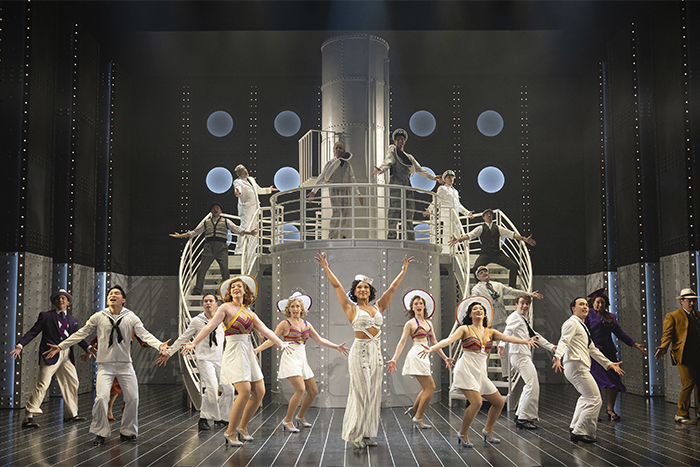
And so it does. Being part of an audience exploding with applause after the title number is a unique theatrical joy, one I was glad to experience here.
In Rampersad’s brisk production, laughs are plentiful, the Cole Porter tune stack is unmatched, and the cast clearly has the memo in hand that this is, well, champagne. I’ve seen funnier Moonface Martin’s than Michael Therriault, but never one as charming. Mary Antonini offers a beautifully sung and playfully danced Reno Sweeney — although I still like Reno to be a bit less glam and a bit more street. As Billy Crocker, Jeff Irving knows how not to cross the line into stalker-ville. Allan Louis is a surprisingly endearing Lord Evelyn Oakleigh, And kudos to Celeste Catena, who manages to make Hope Harcourt more than a plot requirement.
Like “Tons of Money,” “Anything Goes” is theatrical candy. But this candy proved delicious.
 louharry.com