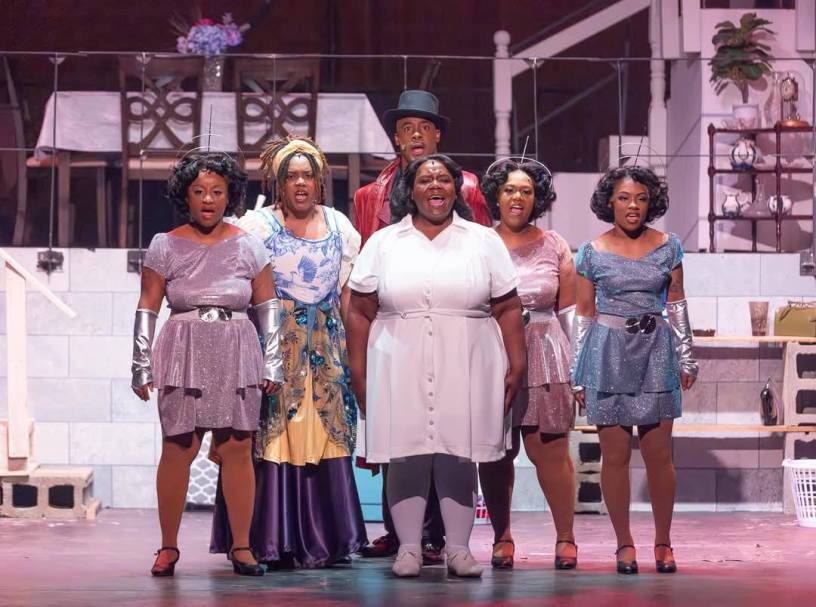
Some thoughts on “Caroline, or Change” at Footlite Musicals plus Southbank Theatre Company’s “Relativity” and the national tour of “Six”:
– I realize many readers are taking a look at this to read about the national tour of “Six,” the Little Engine that Could of musicals that has become a Broadway, London and touring hit. I’ll get to that. You can skip ahead, but I hope you won’t. Because I first want to write about “Caroline, or Change,” the Jeanine Tesori/Tony Kushner musical being given its Indiana premiere at Footlite Musicals community theater. And about Southbank’s production of “Relativity” (noting well in advance that my comments on that show contain a key spoiler necessary to the conversation. Skip over it if you intend on seeing it and appreciate surprises).
– There are some shows whose title, subject matter, and musical structure make popularity an uphill battle. “Caroline, or Change” is one of them. After a run at New York’s Public Theatre, its Broadway stint lasted only a few months in 2004, overshadowed by that year’s “Wicked” and “Avenue Q.” It won awards in London but didn’t transfer to the West End. A later London production starring Sharon D. Clark did transfer but only briefly. Clark headed a Broadway revival that, again, didn’t make it past a few months. While there have been scattered regional productions, this is the first in Indiana.

– While I usually bypass community theater when it comes to productions I write about, I made it a point to catch “Caroline, or Change.” Yes, most of Footlite’s schedule consists of proven audience-pleasers, but few local theaters have Footlite’s sizable loyal audience, its access to musical talent willing to work for nothing, and, as demonstrated here and with its previous show, “Next to Normal,” its willingness to take an occasional big-swing risk.
– The risk paid off. In short, “Caroline or Change” is one the most moving experiences I’ve had in a theater – any theater – since the pandemic shut down.
– Part of that may have to do with surprise. While I had heard the second act’s big number, “Lot’s Wife,” I was not familiar with much of the music or its structure. Its stylistically varied score isn’t one built for frequent play on Sirius XM’s Broadway channel. It’s character- and situation- rather than stand-alone- driven. Closer to Tesori’s score for “Fun Home” than for her “Shrek” songs, as well-sung here, the music serves the story, not the drop-in visitor.
– “Caroline, or Change” concerns a Black woman working as a housekeeper for a Jewish family in the early 1960s. With four children – one overseas – her efforts to get by are complicated when she’s offered the chance to keep any money that finds its way out of clothes pockets and into the aforementioned washing machine. It deals with ethical issues, race, need, generational conflict, parenting, and a lot more. Yet it never feels like an “issue play.” It’s a musical grounded in its very specific characters. Because of that, it pays off in surprising and original ways. There are so many musical theater conventions thrown out the window here. For starters, there’s not a lead couple and a secondary couple. There’s not a redemption arc. And the fantasy moments – including, a singing washing machine, dryer, moon, and city bus – are not there for joyfully wacky shenanigans or diversion.
– Yes, there are resource limitations at Footlite. What it demonstrates here, though, is that the vocal and band talent it has access to is plentiful. All rise to the challenges presented by Tesori’s rich score. In the title role, Damaris Burgin brings gravitas and truth to a difficult role. Bitterness can become trying after a while but not in her portrayal. Other standouts include Zarah Shejule as fellow domestic worker with a sunnier attitude and Angela Manlove, stepping back from her lead role in “Next to Normal,” as the forward-directing Moon.
– And, almost to a person, these characters aren’t folks we’ve seen in musicals before. All the more reason to catch it at Footlite. You are unlikely to have another chance after it closes.
— Like me, I hope you’ll now watch for whatever director Bradley Allan Lowe has in store next.
– Meanwhile, at the Shelton Auditorium, Southbank Theatre Company is offering Mark St. Germaine’s “Relativity,” which deals primarily with Albert Einstein’s family matters.
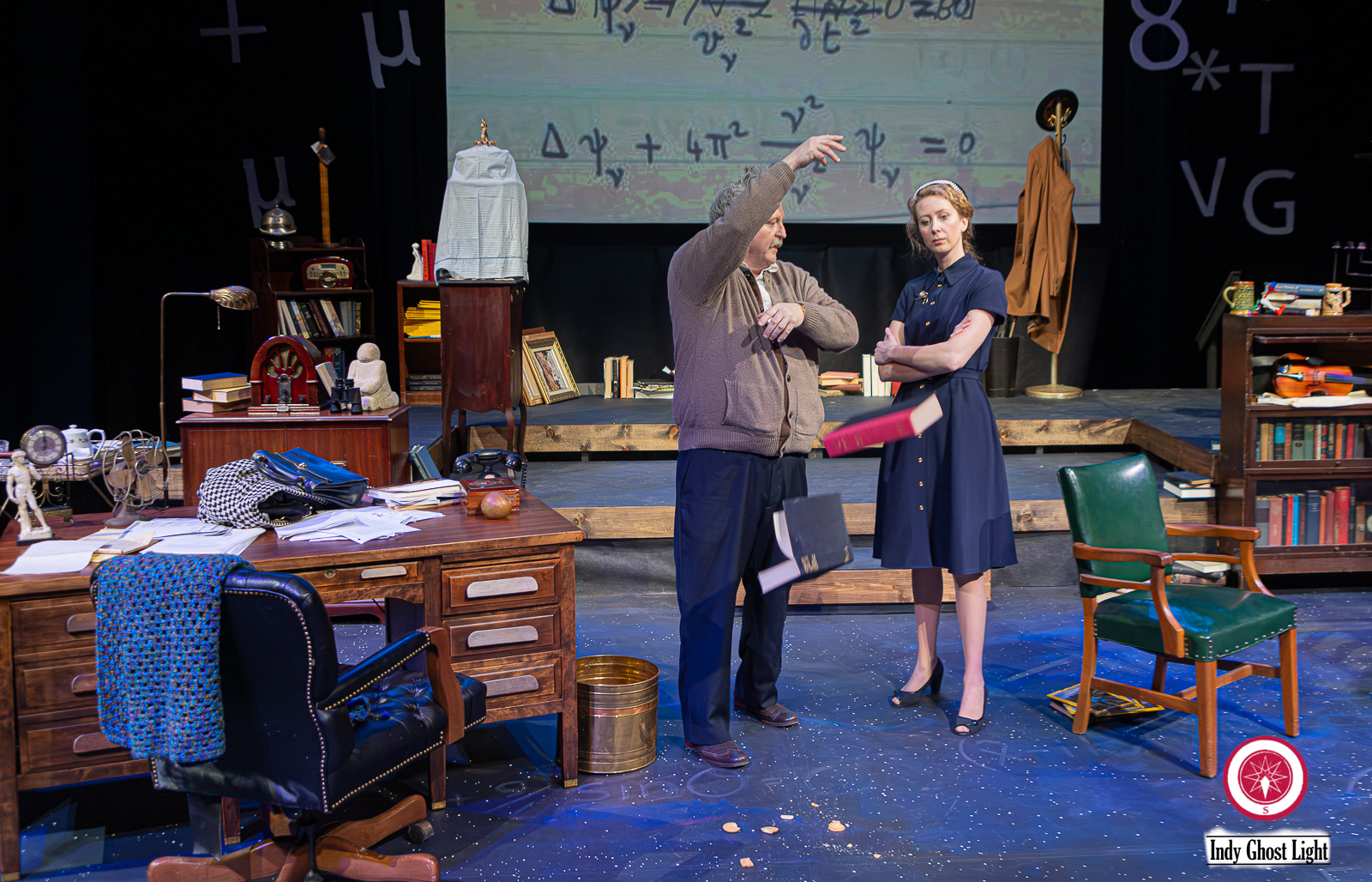
– Smartly directed by Ronn Johnston and with an on-point cast of three (Anthony Johnson, Morgan Morton, Miki Mathioudakis), it’s nicely appointed by Christian McKinney’s scenic design work and company artistic director Marcia Eppich-Harris’ subtle and effective sound design. I was less enamored with the large-screen projections, primarily because, given the shape of the theater, they often distracted rather than accentuated the events on stage.
– What’s on stage, though, is dramatic, thoughtful and well structured. It’s also fiction. While the characterizations may be grounded in truth, the central conceit of the play – Einstein’s daughter confronting him about his life choices – while presented as truth, is entirely made up. Yes, he had a daughter, but nobody knows what happened to her. And the letter projected on screen during the curtain call has been well established as a fabrication.
– Which begs the question: At what point are we comfortable with a play/movie/book having its way with established history?
– For me, what matters is the degree to which the play itself acknowledges that it is fictional. In Katori Hall’s oft-produced play about Martin Luther King, “The Mountaintop,” for instance, the Reverend is visited by an angel on the last night of his life. Clearly, this is a fantasy. In the musical “Ragtime,” the mix of clearly fictional and non-fictional characters make clear that we aren’t expected to buy the specific moments. I fully realize that the farther we go back in history, the more comfortable we tend to be with big changes. After recently seeing a production of “Henry IV” I didn’t feel the need to fact check Shakespeare. And, yes, every play about real life people is built on constructed dialogue (I couldn’t accurately recount dialogue from a dinner I had with a friend last night, let alone a conversation from decades ago.) But while I enjoyed my time with the trio in “Relativity” and appreciated the verbal sparring over whether or not greatness and goodness can be compatible in a single person, my post-show experience, once I learned more of the story, was less satisfying. Specifically when it came to that final projection, I felt (relatively) uncomfortable that folks might have left the theater believing that Einstein had actually written that letter. .
– Keep in mind, the above comments are from a guy who wrote a book on misattributions and misquotes.
— Still, as a play that feels built on theme and debate, it’s an engaging, entertaining one.
– Also playing fast and loose with history is “Six,” visiting Clowes Hall on its national tour. The show’s conceit is that the sextet of wives of Henry VIII have a sing-off-of-sorts to claim the title of the most put-upon spouse. It should come as no surprise that, eventually, they realize that girl power is more important than the patriarchy. Like the last moments of “Hamilton,” “Six” is, thematically, about reclaiming a story – about who gets to tell and define. In one of its most thoughtful moment, it reminds us that most of us really only know about Henry VIII because of his wives.

– Like a nuclear family that upgrades to a 12 bedroom mansion, though, the show has outgrown the space where it’s most comfortable. There’s a chumminess to the dialogue that gets lost in an auditorium this big, gaining an artificiality along the way. No matter how many times the cast gives a “how are ya doin’ Indianapolis” shoutout, the disconnect is palpable. I never thought I’d say “I’d rather be seeing this show in a Las Vegas lounge.” But here we are.
– It also doesn’t help that the sound isn’t great. Even my seat neighbor, much younger than I and uninitiated into much of the music, couldn’t discern many of the lyrics, particularly in the important meta moments later in the short intermissionless show. I usually prefer attending a new musical without having listened to the cast recording but, in this case, I think it would be a benefit since those clearly fully engaged treated this more like a concert than a musical play. And for good reason: The songs are catchy, finding a comfortable spot on a border between Broadway and the pop world with a bit of Greensleeves here, a bit of Spice Girls there.
– Yet while the pulse-pounding songs of “Six” are still in my head days later, the characters of “Caroline, or Change” are the ones in my heart.
— Side note: For more on some of these queens, Constillation Stage & Screen in Bloomington will be presenting the world premiere of a new musical, “The King’s Wife,” in June. It focuses on Catherine of Aragon and Anne Boleyn.
 louharry.com