
It’s been a busy few months of gaming, especially with the growth of Game Night Social at the Garage Food Hall. I’ve been called the game concierge and the game sommelier but, whatever the name, I’ve enjoyed sharing games, teaching games, and watching people have a great time together. Last Tuesday, more than 50 people were playing over the three-hour period, including 6-person games of Alhambra and Bad Company, a quintet visiting Catan, some folks having a very physical game of Heads Up and a pair of siblings having a blast playing Pickleball Blast.
One of the pleasures for me is introducing folks to new games. Here are some that have recently the table.

Rock Hard 1977 (Devir)
Not many games earn a feature story in the New York Times, But this one has, thanks in part to the celeb factor of designer Jackie Fox, formerly of the the band The Runaways (best known for the song “Cherry Bomb’). It helps that the game is anchored in her experience.
Each player is a young rocker, starting with some chops, a little experience, a pair of songs, and a non-musical job. The goal is to acquire fame points by increasing the first three, recording a demo, getting an album deal, and playing larger venues.
The challenge is that you are only one person (yes, this is a worker placement game). You can only take one action in the daytime, one in the evening, and one late at night. Well, you can do more than one if you take some “candy,” but that increases your risk of needing some recovery time. Plus, one of those actions has to be going to your work — or not. Miss three work sessions and you lose your job — which can be fine if you are already getting paying gigs but not great if you aren’t.
The game requires a fair amount of set up time given the number of different cards and small pieces (A friend is 3D printing a organizing insert for me for the box, which will help. I owe him one now.) But the rules are fairly straightforward. In many games, theme feels pasted on. Here, the actions and progression of the game make sense thematically. Of course, for example, you need to record a demo before you can get a record contract. And it stands to reason that hitting the hottest club late at night would earn you a little extra fame. This is one game where reading the flavor text — the writing that doesn’t actually impact the game — adds pleasure.
I’ve introduced this one to three different groups now and all have had a blast with it. Repeat play may drain some of the discovery out of it, but I look forward to introducing it to more first-time players.
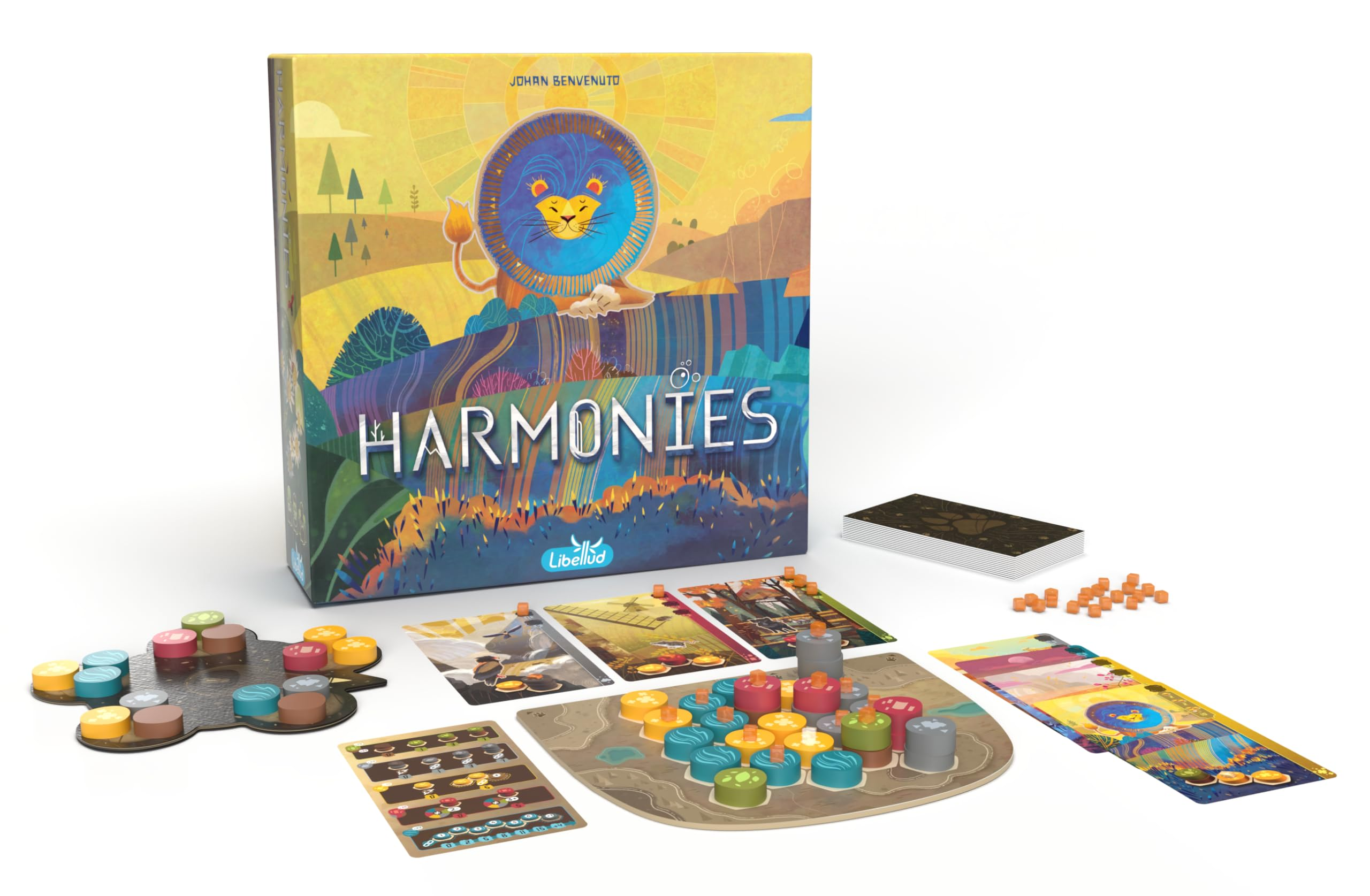
Harmonies (Libellud)
When I first saw Harmonies, I thought it would be, essentially, a three-dimensional Cascadia. That’s not quite accurate but also not entirely incorrect. (Admittedly, I have used that description to get some hobby gamers to give it a try.)
Like Cascadia, you are creating environments and populating them with animals that would naturally live there. Harmonies is more tactical, though, because the tiles you need to create the environments need to be in specific configurations (board-level shape-wise and heigh-wise) and are limited in how many creatures they can hold.
On a turn, players select and place tokens from available sets of them and then can take an animal card and/or place a cube if they have created an appropriate environment for an animal they have collected. Placing tokens isn’t always simple, since some environments require, for insteads, trees that are three units tall — which means you need two brown wood tokens stacked with a green leafy one on top On the flip side, nothing can be put on top of blue water yellow field tiles. And, unlike Cascadia, your playing area is limited to the hexes on the printed boards.
I’ll still play Cascadia — and if presenting games to newbies I’ll probably opt for it before Harmonies — but for gamers who want a little more to think about (and can handle a little more frustration when things don’t work out as they hoped), I’m happy to have Harmonies available.

Trekking the World, second edition (Underdog Games)
I haven’t played every game that’s out there. Truth is, I haven’t even played every game in my collection. So I’ll be upfront and say that I won’t comment on the changes made for the second edition of Trekking the World because I never played the first.
I have, however, had good times with Underdog’s putting-the-company-on-the map Trekking the National Parks (which taps similar pleasures as Ticket to Ride) and Trekking Through History (a less thematic but equally well-designed game). Both are strong gateway games with minimal clutter and an emphasis on design clarity.
In Trekking the World, players in turn select itineraries and attempt to move their trekker to those locations, accumulate money, possibly pick up some souvenirs for your suitcase (the more you fill it with like sets the greater the bonuses) and encounters if your current location happens to match one of the available cards. You may also pay for a tour card, which earns substantial points. Quantities of tours triggers the end game (5 in a 2-3 player game, 4 in a 4-5 player game).
Like the above-mentioned Underdog offerings, this one is designed to be non-intimidating and lightly educational without feeling like a classroom exercise. It’s bright, breazy and provides another gateway for hobbiests to lure their mass-market gamer friends and family over to the meatier side.

Survive the Island (Zygomatic)
Here’s a reskin of an older game that I actually had played previously. Here you aren’t trying to survive on an island, you are trying to get as many of your meeples to escape as it sinks around you. Compounding the challenge are limited boats, shark- and dragon-infested waters, and a wandering kaiju (who could also possibly help you).
This is a throw-your-friends-to-the-shark-so-you-can-stay-alive kind of game and that cuthroat element — whimsically illustrated on the box cover — is a big part of its pleasure. Saving a majority of meeples, though, still may not give you the win since each has a value that you can only see at the beginning of the game. Keeping track of where your high-scorers are can give those with good memories an advantage.
The companants have been upgraded as has the rule set. I anticipate this one will survive many a game shelf purge.
Chronicles of Light: Darkness Falls (Ravensburger)
Through Villainous and other series’ of games, the folks at Disney have embraced the idea of melding worlds. In that case, the competition is between various baddies. Now comes what looks like the first in a series where the heroines get a chance to show their teamworking stuff.
In this case, Belle, Moana, Violet (of Incredibles fame) and Maid Marian get things rolling.
Some co-op games have minimal interaction. In this case, helping others can be key. Here, each character has her own quest — the game offers multiple ones to give some variety to subsequent plays. In addition, shadows and a mobile vortext have to be eliminated to prevent the titular darkness from fallling. And there’s a big shared objective at the end.
Much of it is pick up and deliver, but with obstacles and choices to be made along the way. Each character has her own thematically connected action tokens, there’s variability in the map layout, and there’s a solo version, sort of. You actually play as two of the heroes.
Make no mistake: This is a light, family-weight game that stretches credibility a bit thematically. Worth a visit for Disney completists and playable for those looking for relatively low-key board gaming adventure with familiar characters.

Knarr (Pandasaurus)
While I take great pleasure in teaching games at Game Night Social, I equally enjoy learning them. Some kind folks recently welcomed me into their game of this Viking recruiting/exploration/treasure acquisition game and after one game I was hooked.
The game starts off easily. You claim a viking to join your crew. Each has a single icon on their card indicating its effect — adding a victory point, moving ahead on a reputation track that leads to recurring points and other bonuses, acquiring a bracelet (used later for trading) or add a generic recruit to your team. In most cases, it’s best to find one of the same color-coded clan as one you already have in your array since you also get the bonuses of those as well.
Alternatively, if you have enough strength, you can explore a territory and add its card to your board. This opens up a new traditing route so you can swap those bracelets for more bonuses. It can also give you more victory points.
The rules are fairly simple, but the strategy is real given the limits on your resources (you can only have three bracelets and three recruits). Luck kicks in since you have no control over the available Viking cards.
Weight-wise, it’s in league with Splendor and Century, games where building an efficient engine is key. This one feels a little more thematic than those two gems, while earning a spot next to them on that 30-minute-of-so game shelf.
 louharry.com