No excuses.
Okay, excuses.
Between hosting Game Night Social weekly at the Garage Food Hall (where many of these games were played), directing a pair of plays, completing freelance writing assignments, maintaining the full-time gig and…okay, I’ll stop now.
Here are some thoughts on games I’ve recently tried. Promotional consideration has come, in some cases, in the form of review copies offered without obligation or expectation.
More to come. I promise.
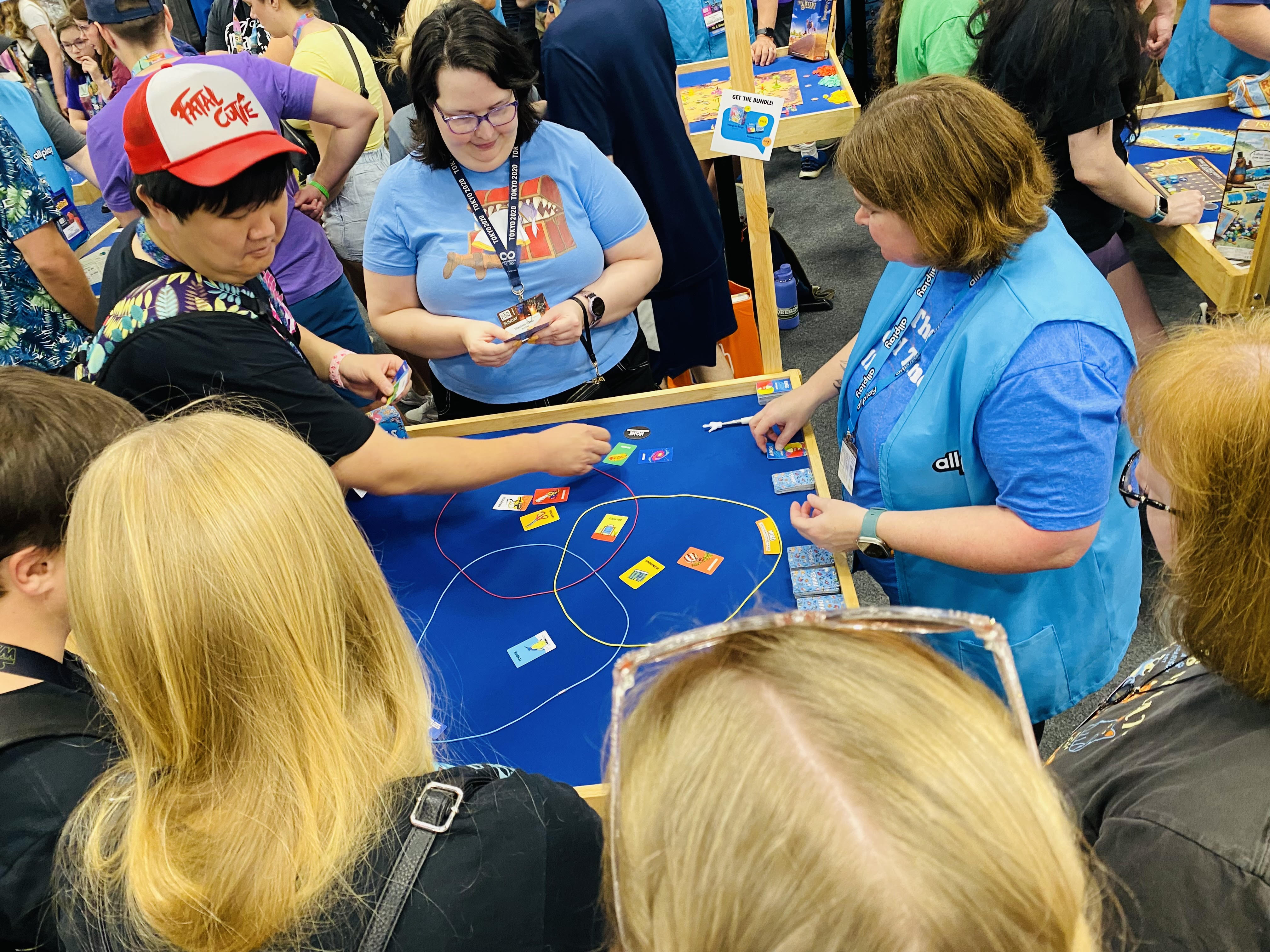
Things in Rings (Allplay)
At Gen Con, nobody really knows what’s going to be hot from among the 500-plus games being introduced by game manufacturers from around the world. You can build the slickest booth, hire the friendliest demonstration team, manufacture the coolest components and give it the trendiest theme, but you still might get outsold by a more modest game with an easy-to-grasp rule set.
Such was the case a few years back when a small booth in the back of the packed vendor hall was consistently packed as it introduced Codenames, now a mass-market tabletop game blockbuster with an array of sequels and spin-offs. Although it is unlikely to reach those heights, one such low-key winner this year was Things in Rings, which had consistent crowds gathered around its demo table in the vendor hall. And that crowd tended to be loud, high-fiving at correct answers, laughing at mistakes and having a grand old time – even if they were just watching..
Things in Rings is the kind of kitchen-table game that lures people in. Even hardcore gamers at Gen Con were fascinated and silently playing along even if they weren’t actually in the game.
The game, retailing at the con for only $17 (MSRP is $19), consists of little more than a stack of word cards and a trio of colored rings. The rings are placed together in venn diagram formation with each assigned a rule known only to one player (for instance, “has one or more repeated vowels” or “could help you survive in the wilderness.” The rest take turns trying to discern those rules by guessing where their word cards belong.
While Trivial Pursuit in the 1980s ushered in a parade of games designed to show off your smarts (and intimidate those less fact-endowed), these days you are more likely to find games that rely on deduction rather than knowledge. And success isn’t pass/fail. With Things in Rings, guessing is more than possible, it’s expected, especially early in the game. Don’t have a clue where one of your words belongs? Take a wild guess. You might be right. And even if you aren’t and you have to draw another card, your original word will be put in its proper place, giving you additional clues to help on your next turn.
To further reduce that intimidation factor, board game companies have increasingly realized the importance of scaling. That means a game you might play with your college buddies may also be playable with your young kids. In the case of Things in Rings, you can adjust the number of rings you play with and the severity of the rule cards to find the sweet spot that keeps the game challenging while staying short of brutally difficult.
Link City (Blue Orange)
While competition has long been a key ingredient in tabletop games, cooperation, consensus and collaboration have inched their way into the gaming world. At Gen Con, “Is it a co-op?” is a common question, with many gamers looking for titles that allow them to work together to beat the game rather than each other.
Case in point: Link City. Here, players take turns being the mayor of a developing city. It starts simply, with a City Hall tile neighbored by four randomly selected other locations, say, a tattoo parlor, an organic supermarket, a skate park and pottery studio. Each turn, a different player is the major, who has to secretly decide where to place three new locations. It’s up to the rest of the players to guess what placement the mayor has in mind. Should a hospital go near the skate park? Does an hourly motel belong near a French restaurant? Make a match and the tile stays and the connected tiles form a tree. As the city grows, so do the options for placement and, in the end, a collective score is determined by how many trees are in your town.
These co-op games are sometimes looked down on by serious hobby gamers, who label such titles as “activities” rather than “games.” In them, the pleasure comes primarily from the process rather than strategizing to achieve higher points or landing a Q on a triple letter score and beating your brother at Scrabble. Where, they wonder, is the fun if you can’t show your superiority?
But for others, co-op games offer a more engaging experience for the right group, working best when there’s buy-in from all parties at the table. One person with a “whatever” attitude can drain away the fun.
And co-op doesn’t mean a game can’t have an edge. In the latest edition of the popular game series Horrified, for instance, players team up to defeat the Sphinx, a Yeti, and more. Like its predecessors, failure is an option. Even more intense is Masters of Crime: Vendetta – a variation on popular escape-room games – where you take on the roles of mafia hoods summoned by the Godfather to suss out a disloyal family member.
And, briefly:
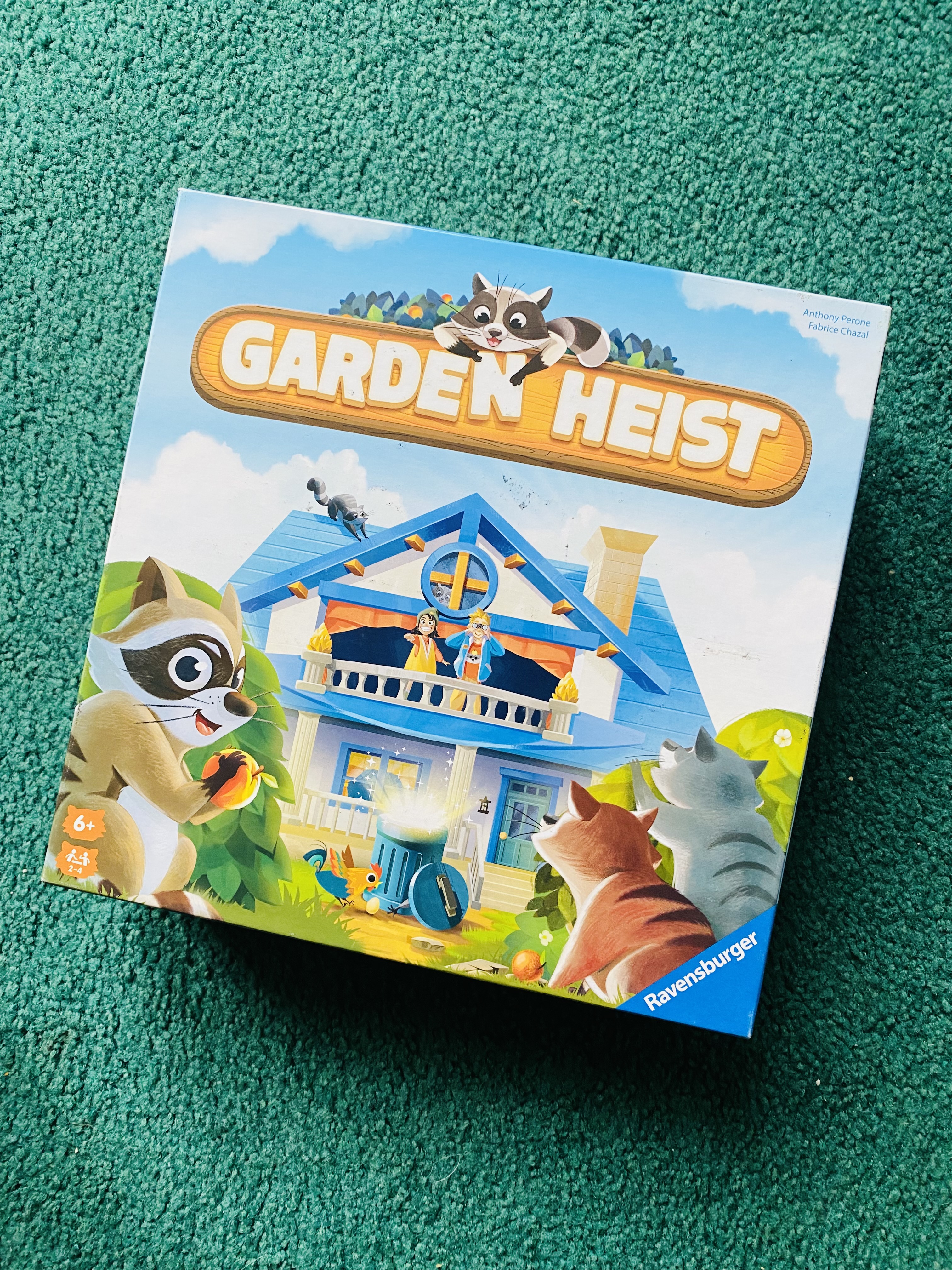
Garden Heist (Ravensburger)
In thisi creatively designed hide-and-seek game in which players each take a turn being the gardener while the rest are raccoons. The goal for the raccoons is to reach the trash can (duh). The goal for the garderer is to spot the raccoons before they get there. Each turn, while the gardener has eyes hidden behind a cardboard house, the raccoons secretly decide where they are moving to on the garden board. When all are in place, the gardener opens the window and takes a guess. Each space is hidden–or partially hidden–so it’s a guessing/deducation game make more playful by the fact that, if the raccoon is on certain spaces, they must make immitate a dining raccoon. While the game is labeled for ages six and up, younger kids will likely need parents to do the set up.
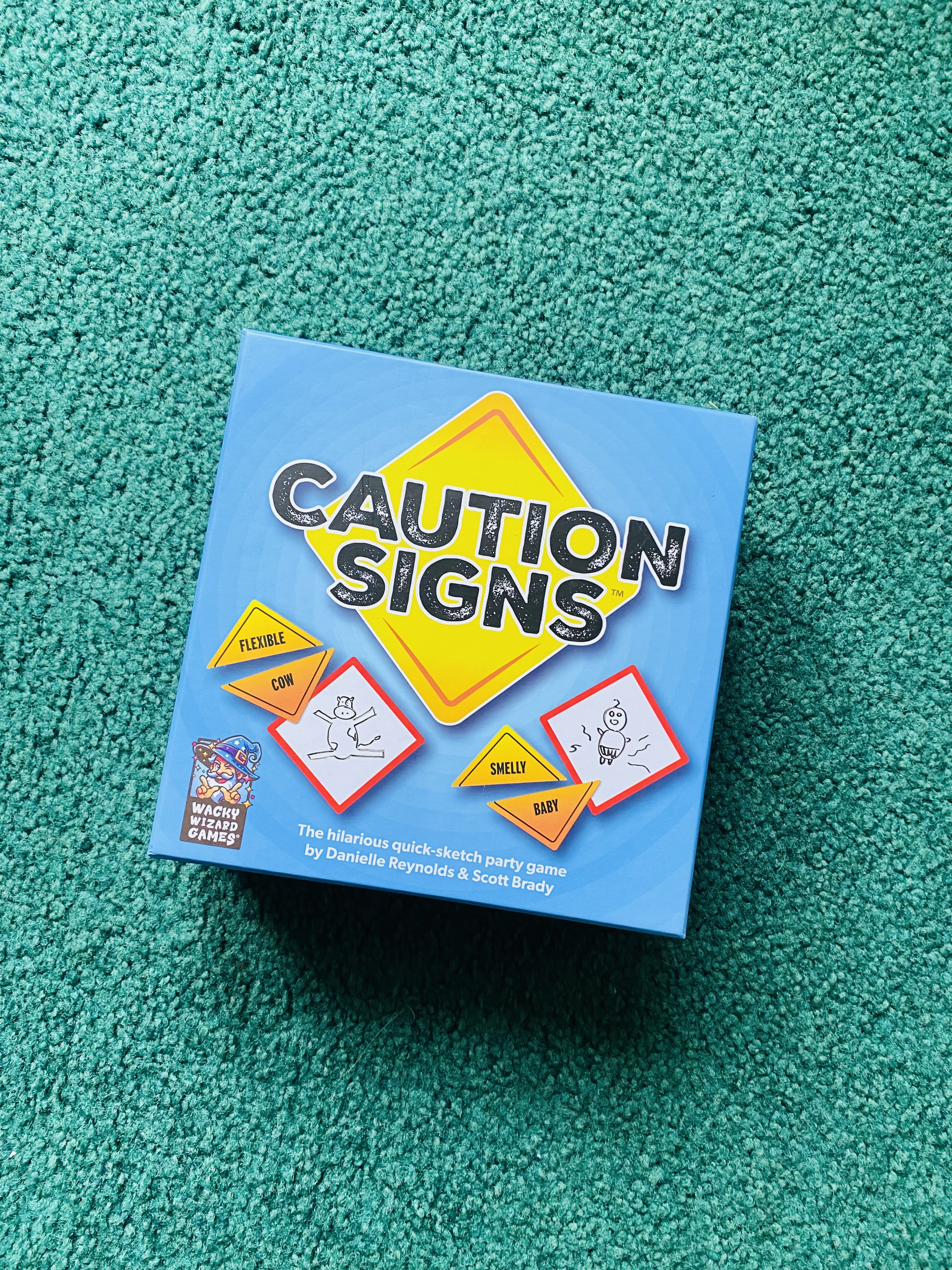
Caution Signs (Wacky Wizard Games)
A rapid-fire drawing game in which players have twenty seconds to quickly draw a picture that incorporates two randomly drawn words or phrases, one from the Signs pile and one from the Caution pile. Crawling and Teacher, perhaps. Or Sparkly Dolphin. After time is up, the dry-erase-board drawings are shuffled and revealed. More random cards are shuffled into the word piles and they are revealed. The challenge is for the guesser to figure out which words go with which drawings. Caution Signs is a quick-learn party game likely to generate a fair amount of laughs with little concern, ultimately, with points. In many such party games, it’s best to have the rulebook open to the scoring section until you get used to the system — or close it and ignore the scoring completely.
Da Da Da (The Op).
This one’s a Dud Dud Dud. I’ll leave it at that.
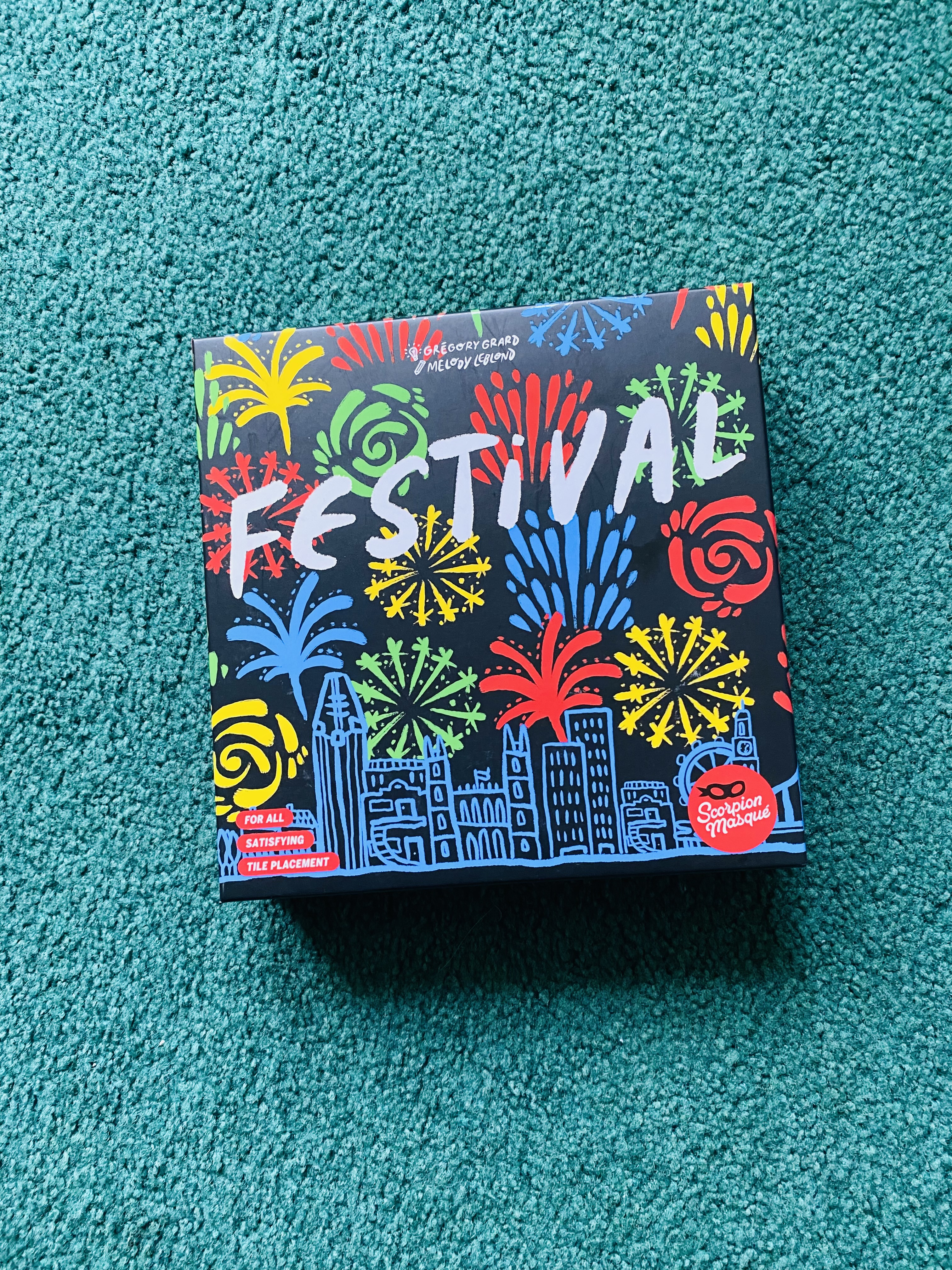
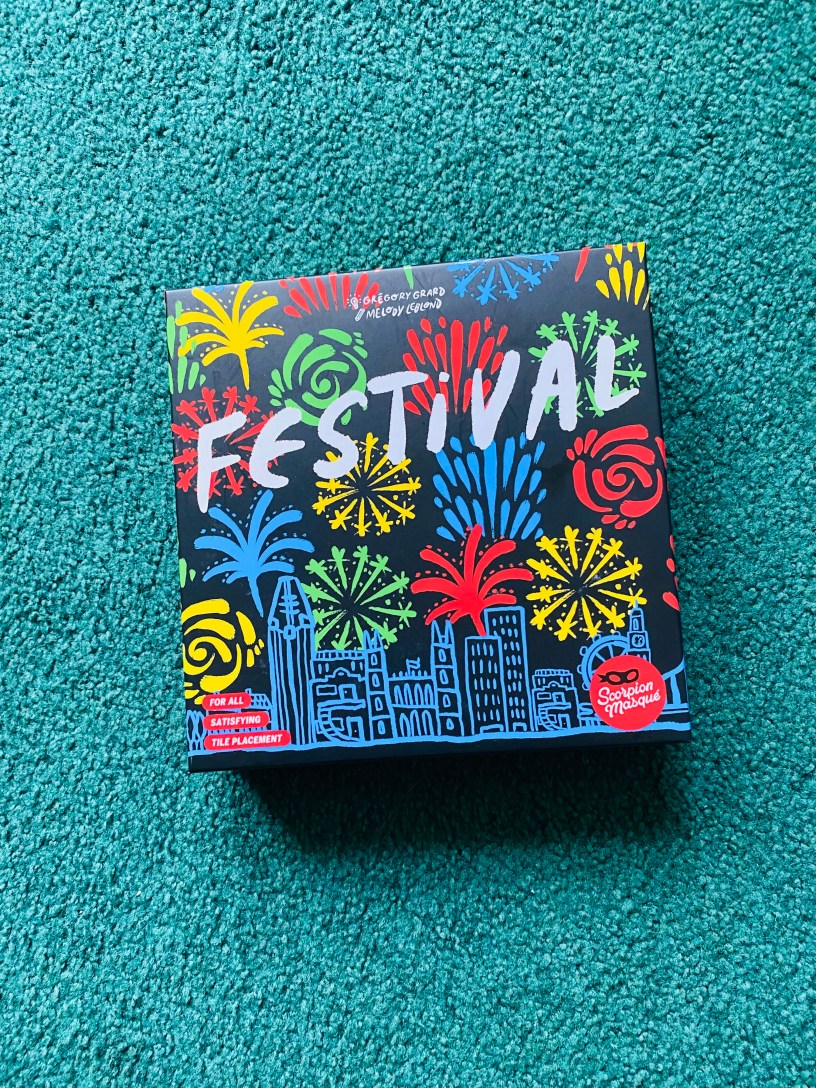
Festival (Scorpion Masque)
A vibrant design highlights this tile-laying game in which each player tries to create a fireworks display that matches their accumulated objectives. On each turn you can either pick a tile to add to your nine-disc display or select an objective based on the pattern and colors you’ve coordinated — or those you hope to coordinate. There’s nothing new here but that doesn’t keep it from being a fun filler, with each game clocking in at about 20 minutes.
Crash the Party (Blackrock Games)
Creative but a bit clunky, this party game is actually about going to parties. Each player has an invitation that they secretely slide into the deoder box, which tells them what event they will be attending. One, however, does not have an invite. Each player than picks something from their hand of cards to take to the party and reveals it, explaining why. All players discuss, accuse, etc. and then collectively point to who they think is the crasher. The result is okay for a round or two, but quickly becomes rote, with diminishing pleasure returns. Ultimately, this is a clever, original device in search of a decent game.
 louharry.com