
Indianapolis Black Theater Company launched its first full season with “Toni Stone” (through Oct. 6) at its home base, The District Theatre.
Some thoughts.
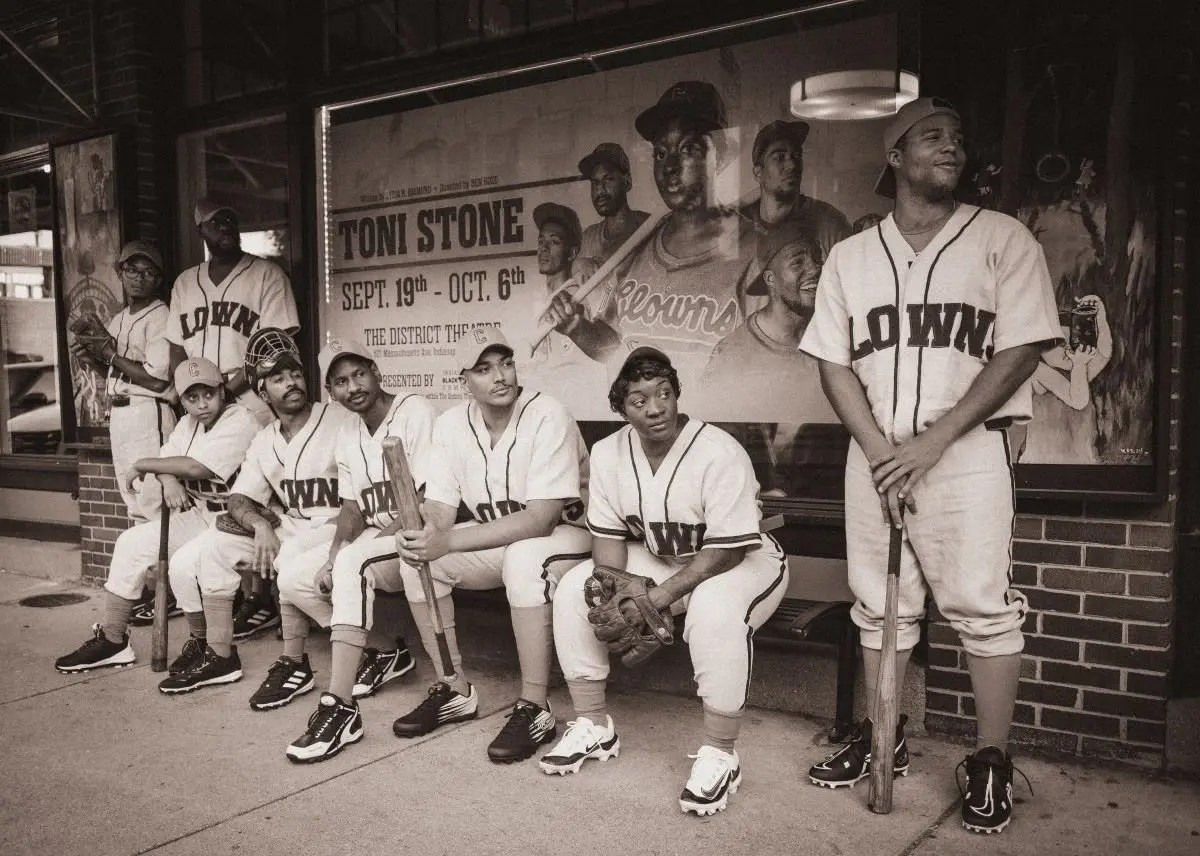
— Even before you get to the theater, it’s clear that care has been taken by IBTC to send the message that it is a fully professional company that not only cares about what’s on stage, but what surrounds it. Specifically, it not only took outstanding, evocative publicity photos (something many companies can learn from) but it also finally made use of the District Theatre’s public-facing picture windows. For years, these were neglected as opportunities to alert pedestrians as to what was going on inside. IBTC, on the other hand, has taken full advantage of this unpaid advertising space. Result: The sense that you are in the hands of professionals.
— Converting the District Theatre’s cabaret space into a lounge with Negro League footage playing is another outstanding use of space. Here’s hoping for more such off-the-main-stage environments to enhance theatrical experiences.
— Structured nonlinearly, Lydia R. Diamond’s play centers on its title groundbreaker, the first woman to play as a regular on a major professional baseball teams. The fact that her team, the Indianapolis Clowns, was part of the Negro League means that her story has been largely unfamiliar, even to sports fans, until Diamond’s play received an off-Broadway airing sparking productions around the country. Not mentioned in the IBTC program: It was inspired by the book “Curveball: The Ramarkable Story of Toni Stone, the First Woman to Play Professional Baseball in the Negro League” by Martha Ackmann.
— Offering its local premiere, IBTC has filled out the player roster with a talented team that includes seasoned vets, familiar local faces, and some relative newcomers. The mix works, creating a squad of personalities that pop.
— Much of the weight of the play, of course, falls on PsyWrn Simone as Stone. It would be easy to fall into the trap I’ve seen in other plays of making a period heroine too contemporary — of playing the virtue rather than the person. Simone — and playwright Diamond — effectively dodge that, giving us a woman who is talented but not flawless, confident but not cocky, and smart but not educated. Granted she occassionally comes across as a bit “Rain Man”-esque when reciting stats, but that’s a quirk given her by Diamond that’s difficult to make completely believable.
— The play does offer insight into the challenges of rising to great heights in your field all the while knowing that those in your field are being treated unfairly. It also only touches on the compromises required of these talents to, as their team name suggests, clown. Not just atheletes, these players needed to be entertainers in a way that pleased and appeased white audiences. Act one ends with such a scene, but here it lacks a clear point of view about the complex compromises such clowning demands.
— The biggest issue that keeps “Toni Stone” from having a stronger batting average is pacing both in the production and the script. While individual scenes work, there’s not enough story here to justify the show’s length and not enough of a character arc or forward motion in her story to keep some sequences from seeming arbitrarily placed or not necessary at all. The issue is ascerbated by transitions that take too long and dialogue exchanges that could and should be tightened. You can debate amongst yourselves whether it’s better to add incidents to a real-life story to give it more structure or if its best to accept that a person’s life doesn’t conform to expected dramatic structure. Whatever the case, there’s more “and this happened” and not enough “and this led to this which led to this.”
— Still, even those not passionate about baseball are likely to see, through Stone and her teammates, why they are passionate about the game.
— And to have the play offered in Indianapolis, where much of the story takes place, is a wise move for this promising new company.
 louharry.com