
Before diving into some reviews, here are some that appeared elsewhere. For Mirror Indy I wrote about Ten of the best non-initimidating games I found at Gen Con this year. If you are looking for easy-in games, check those out. For Indianapolis Monthly, I penned a trio of pieces on specific games. Only one has appeared so far. Read about Kurt Vonnegut’s game GHQ, which will be getting a release this fall. I’ll try to update this when those other two stories are posted. Earlier in the summer I wrote about bars and game stores with good selections of games to take off the table or shelf and play all year long. Find that one here.
And now to some of the Gen Con acquisitions that I didn’t cover elsewhere. Note that some of these were provided as review copies from game companies without any expectation or requirement.

Gnome Hollow (The Op).
One of the hot games of Gen Con was this tile-laying title in which players take turns extending garden paths, scoring varieties of mushrooms, and cashing them in for victory points. The stretegy kicks in as you decide whether to complete easy, shorter paths or take chances and go for longer ones. For those, the payoffs can be much greater but there’s a risk of not completing. Decisions also have to be made about when to send one of your gnomes to market. Since you only can move one gnome per turn, in some cases cashing in at the market means not claiming a completed path. You are also incentivized to build longer paths since ones made up of five or more tiles score bonuses and better move along a final scoring ring marker. Our only minor setback was some rule confusion regarding flower tiles and tokens (which was sorted out thanks to the online version at boardgamearena.com). There’s an advanced version included but I anticipate many more plays of the pleasant basic one before diving into that. Bonus points for megnetic player boards that help keep ring markers in place.

River Valley Glassworks (Allplay)
When you play Sky Team, part of the pleasure is feeling like you are actually trying to land an airplane safely. Playing Ready Set Bet is designed to capture some of the energy of an actual visit to a racetrack. For games such as these, theming isn’t just decoration. It helps define and enhance the experience. And then there are some that don’t. When playing River Valley Glassworks, for instance, I never once felt like I was a forest animal building a business. And that’s just fine. Sometimes, theming is just a way to give color and character to an abstract game. And if the game is fun enough — which this is — and strategic enough — which this is — that’s quite enough. In River Valley Glassworks, you are collecting glass out of a river by placing a piece of your glass in taking the glass pieces either next to them upstream or downstream and then putting them in your glassworks in such a way that they create the best scoring outcome, which is based on rows of different glass colors as well as on your two greatest quantities of colors — but if there are ties then the furthest to the left, which are lower scoring count and… I’m going to stop here because this is making the game sound more complicated — and less engaging — that it is. Let’s just say that this one is a winner. You can try it out at boardgamearena.com (there, I mentioned it again) and if you happen to play against WildwoodLou, well, please say hello in the chat.

Robot Quest Arena (Wise Wizard Games).
I’ll admit, up front, that I’m not a big fan of skirmish games — ones where the bulk of the mission is to delete the health of the other players, score a knockout, or otherwise pummel your opponants into submission. I don’t object morally to them. These are just games, after all. I just never really enjoyed Rock ‘Em Sock ‘Em Robots or their more evolved offshoots such as Funkoverse Games (as amusing as it may seem to pit the Golden Girls against Mr. Koolaid and Jurassic Park dinos), Heroclix or Heroscape. No offense and more power to players who enjoy them, they just aren’t my thing. And so I approached this robot-vs-robot game with a bit of hesitation. Surprise! Robot Quest Arena is staying in the collection. While there isn’t really a quest (as per its name) there is an arena and there are robots. And they battle it out through basic deckbuilding to accumulate energy (for movement and purchasing power) and weapons (for, you know). Why did this one win me over? In part, because the iconography is clear, the robots chunky and charming, and the health and victory point system easy to manage. I also like when the end game is in sight for all and strategies change with that knowledge. I look forward to teaching this one and watching battles play out. (And, yes, there are additional robots available.)
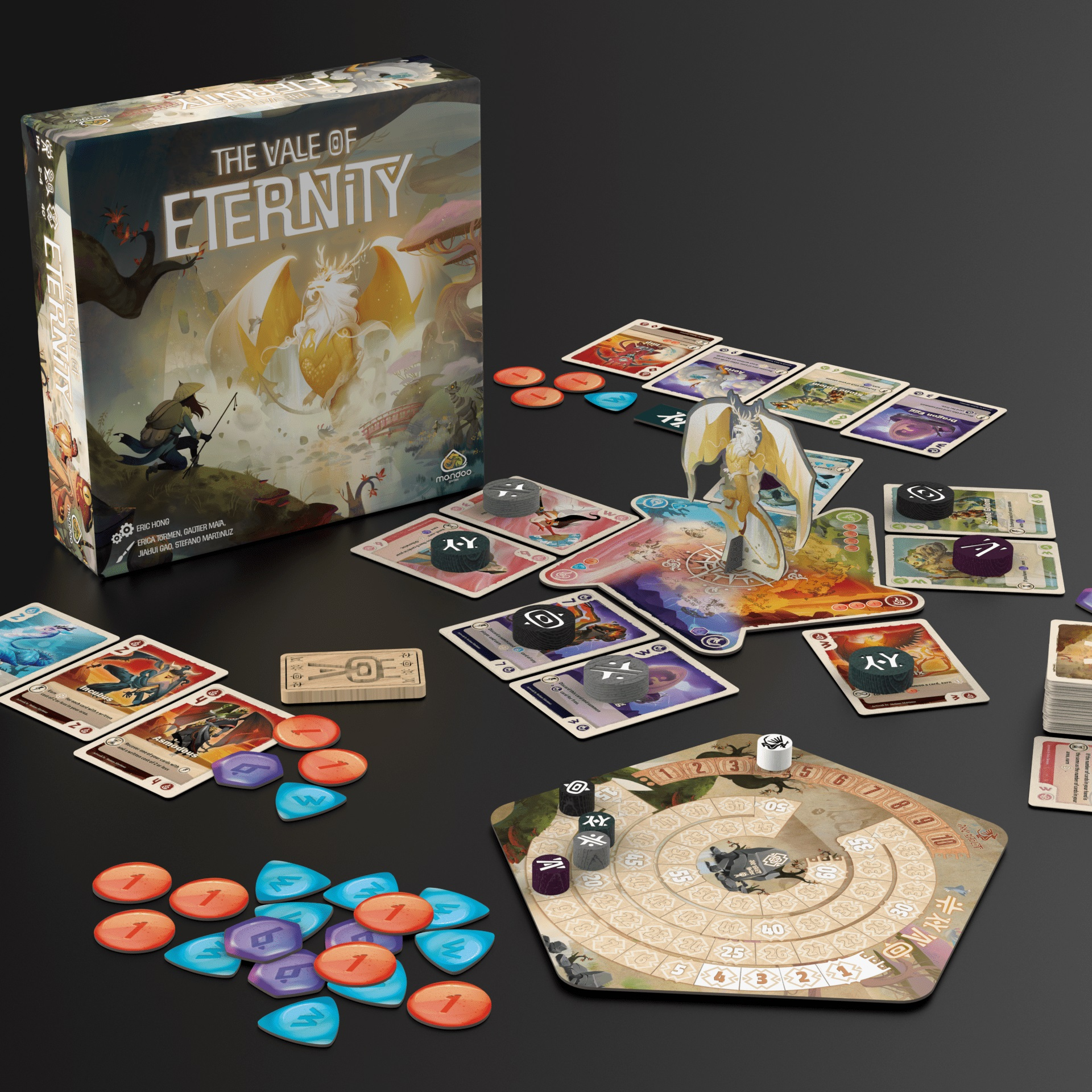
The Vale of Eternity (Renegade Game Studios)
Monsters! Spirits! Gods! And none of them really have much to do with game play. But, heck, flavor art doesn’t make any difference to game play for Dominion, one of my top 10 all-time games, so why should it here? In The Vale of Entertiny, first you hunt, doing a snake draft to place your tokens on cards that have been dealt onto a game board that’s divided into four sections. In the action phase, you can sell cards you claimed (what you get for them depends on which of the sections they were parked on), tame cards by putting them in your hand, and/or summon them by paying the price on them and adding them to your tableau. Some get you immediate actions, others have ongoing actions that play out in the resolution phase. While the theme and design feels a bit generic, a few mechanics help elevate this one. First, you can only hold four tokens at at any times. That applies whether you have four purples (worth 6 each) or four red ones (worth only 1). Further, making change isn’t allowed, so there’s interesting decisions to be made about when to collect and when to spend. Also, the maximum number of cards in your tableau can’t exceed the number of the round you are in. So, in the first round, you can only have one card out. This not only forces thoughtful decisions but also allows the game to build as the rounds increase, making the game less intimidating to begin with and a bit more (but not overly) complex as it progresses toward the finish. You can pay to get rid of a card from your tableau but it will have a destroy cost equal to the round number, which can get pricey. The game ends after someone has reached 60 points or the 10th round is complete. Either way, it makes for brisk gameplay that’s far better than the box would indicate.
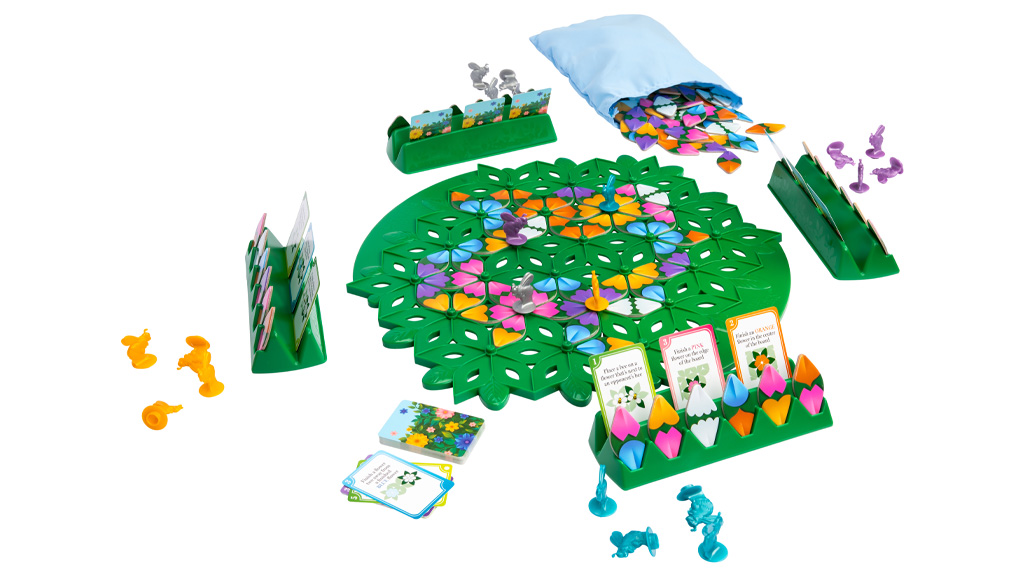
Wild Flowers (Moose Games)
Table presence is certainly a plus with this addition to the current harvest of nature-focused games — a theme that seems to now rival dungeon crawls and superheros in the hobby game world. The rules are simple here. You can play 1-3 pedals from your rack with each tile touching another tile and petal colors needing to match. Park one of your five bumblebees on a tile to claim it and, when it is complete, score points. You also score points for completing secret objective garden cards (i.e. Finish a flower next to a finished blue flower). And that’s pretty much it. The game ends when a player has five bumblebees on finished flowers. There’s nothing bold or original here and variety isn’t in its bouquet, but Wild Flowers is a smartly produced, lightly strategic gateway game that delivers what it promises.
Sacred Valley (North Star Games)
A more involved nature-focused game, this one involves terraced farming. Each player starts as a farmer specializing in one crop. On your turn, you can purchase seeds, plant crops, develop new technologies to learn to plant others, harvest crops or hire specialists. Planting seeds makes your harvesting more
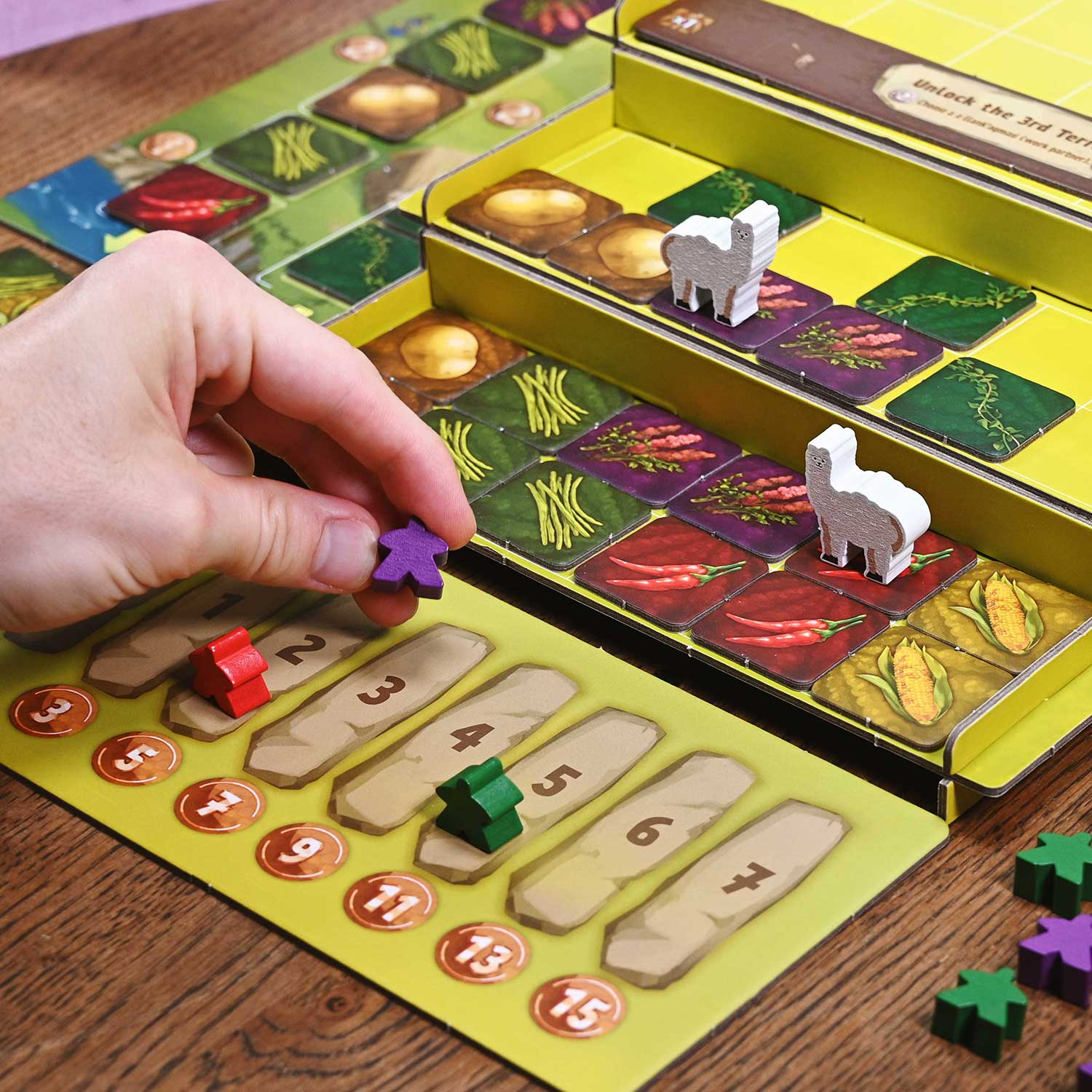
valuable, but since you are planting on shared space, you could be helping someone else while you also help yourself. The specialist option doesn’t seem to have been as well integrated as the rest of the elements and, for some, the options presented each turn — and the math involved in figuring out which is optimal — may be a little off-putting. But I appreciate the tightness of the board and the limitations it imposes. When to move up to another level on the terrace, for instance, or whether or not to add a technology to take advantage of someone else’s groundwork, add up to a surprisingly think-y, competative experience disguised as a peaceful nature game.
More to come. Comments welcome on any of the above.
Happy gaming.
 louharry.com