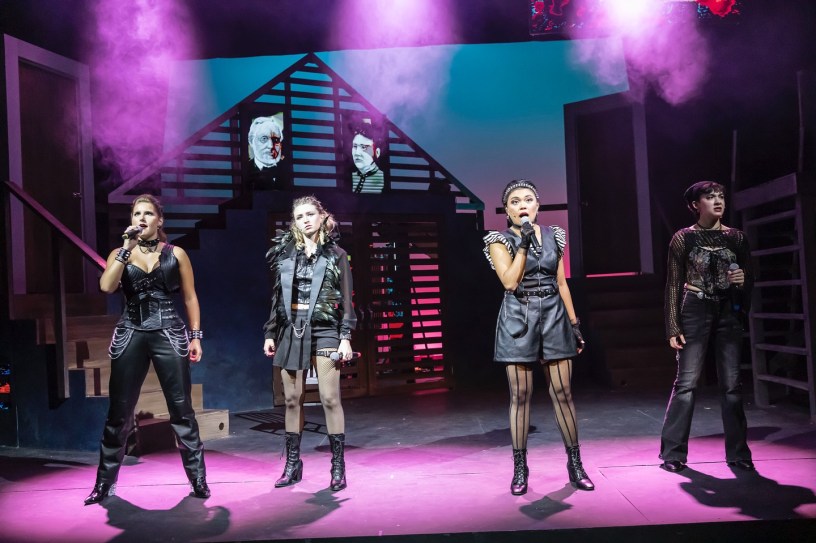
(photo by Zach Rosing)
Musicals are the stock in trade for Summer Stock Stage, presenting shows under its Mainstage (8th-12th grade) and Eclipse (professional) banners. I caught one of the final performances for “Lizzie,” which was one of the latter.
Some thoughts:
– Parked comfortably near the intersection of “Spring Awakening,” “Bloody Bloody Andrew Jackson” and “Six,” “Lizzie” (music by Steven Cheslik-deMeyer and Alan Stevens Hewitt, lyrics by Cheslik-deMeyer and Tim Maner, book by Maner) relies heavily on vocal power and musical energy over plot progression or character development. As such, “Lizzie” feels as much a concert as a musical play.
– That’s not a criticism, but it does raise the question of whether “Lizzie” (and, for that matter, “Six”) is an anomaly or a harbinger of things to come. The accepted “rules” of musicals change over time. The average musical from the 1910s is a significantly different beast from the average show of the 1950s. And those mid-century audiences may not recognize some of today’s new tuners. (What would they make of “A Strange Loop,” for instance.)
– There is a plot here. And characters – four of them onstage, others referenced – but it’s the songs that drive it, not the drama. Whether or not Lizzie Borden actually took an ax to her parents – as the jump rope rhyme you are probably hearing in your head right now bluntly states – is still debated. In this musical, though, there is no debate. That creative choice keeps this from being a mystery and more of a revenge/empowerment tale
– The challenge is making a double murderer sympathetic. That’s not too difficult when it comes to the whacking of Lizzie’s sexually abusive father. The killing of her stepmother is given less attention and its justification more debatable. While Sweeney Todd may generate some sympathy because of the crimes of others against him, his later murders aren’t presented as empowerment, as it often is here.
– To its credit, “Lizzie” does not present the title hero as someone completely in control of her mental faculties. While the audience I saw it with seemed to treat her as a hero, she remains one disturbed young woman. Yet the show still feels like it’s in her corner.
– For some, the term “summer stock” may imply “thrown together,” but the work from all of the above is on par with the best of Indy theater. Choreographer Darian Wilson, Set Designer Abigail Wagner, Lighting Designer Gwendolynn Coffee, Sound Designer Todd Mack, Costume Designer Allison Jones and Video Designer Zac Rosing all elevate the material. I mention them all because the Phoenix mainstage is a challenging space and this team has made it work.
– Oh, and this cast ROCKS! Erin Lambertson offers a fully committed Lizzie, Mai Caslowitz is a sympathetic Alice, who pines for Lizzie, Samantha Ringor is the audience-connecting maid Bridget/Maggie, and Cora Kendell in the less integral role of Lizzie’s sister Emma, all display vocal chops that make you wonder how they could possible do more than one show a weekend. They have been guided by director Devan Mathias, who demonstrates a crystal clear idea of what this show isn’t, what it is, and what it can be. She hit the target, dead on.
– In addition, “Lizzie” serves as a reminder that I really need to see more of Summer Stock Stage’s work. I’m already looking forward to next summer.
 louharry.com