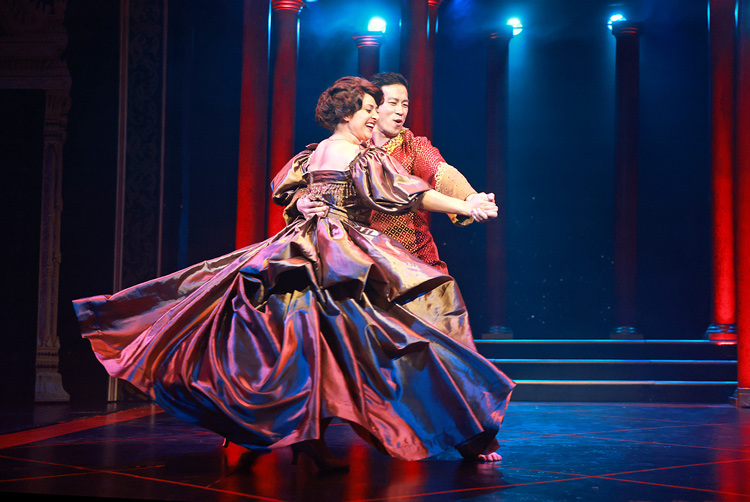
(Photo by Rob Slaven / IndyGhostLight.com)
I recently caught two Rodgers & Hammerstein musicals in very different venues and by very different companies.
Some thoughts.
— Chronologically, “South Pacific” and “The King and I” come from an interesting spot in the career of the legendary team of Richard Rodgers and Oscar Hammerstein. Having altered the musical theater landscape with their one-two hits of “Oklahoma!” and “Carousel” — both adapted from earlier plays — they attempted an original, “Allegro,” which was far less successful (and is rarely revived or even thought of by theater fans). Returning to adaptations, they reignited the Broadway box office and regained critical kudos with these two shows in 1949 and 1953. Both had long runs and long lives on stages around the world.
— Both also reflected a confident progressiveness in Hammerstein’s book writing and lyrics. In both (and in their next show, “Flower Drum Song”) he showed serious effort in attempting to reach mainstream audiences with messages of racial and ethnic tolerance. Unlike other musicals of their era, these shows haven’t gone through extensive rewrites to make them more palatable to contemporary audiences, even if some elements haven’t aged ideally.
— Beef & Boards’ Dinner Theatre’s “The King and I” (running through May 19) takes a step forward from past productions by reminding us, in casting, that the real “I” was born Anglo-Indian and by not casting Caucasian actors in the Siamese roles. Of course, the story is largely fictional beyond the core idea of an outsider brought to teach children in the Siam court. But within the framework of R&H’s creation, the smart choices diminish the yellowface cringe factor of some past productions.
— It also helps that Jae Woo and Hannah Louise Ferenandes as King Mongkut and Anna Leonowens are credible antagonists/protagonists. “The King and I” is a rare show from the Broadway golden age that doesn’t rely on a traditional romance between its leads. But while the love songs are prescribed to the secondary couple, the real test is if the chemistry between the title duo is palpable when the polka music kicks in and the two answer the question “Shall We Dance.” In this case, it does and the scene proves a joy (choreography credit to Jennifer Ladner).
— Beyond the leads, there’s a solid ensemble here. Few have much spotlight time, but they make the most of what they are given. I was particularly taken by a final, wordless moment from Lady Thiang (Nathalie Cruz) as she mourns the loss of King Mongkut while looking with hope to her son.
— Full disclosure: This was my first full viewing of “The King and I.” I have seen filmed and filmed-from-the-stage versions — plus a truncated version at a summer camp where I worked one summer — but never caught the entire show live. (I left at intermission when the rickety Haley Mills-starring late-90s national tour.) The Beef & Boards production made a good case for the show remaining worth revisiting.
— I have seen “South Pacific” in prior productions — including at Beef & Boards. But none — not even the acclaimed Lincoln Center revival in 2008 — won me over like the Indianapolis Symphony Orchestra’s concert version did. Years ago, the ISO staged a concert version of “Guys and Dolls,” which I saw at a Friday matinee. It was so entertaining that I returned for the evening show. Had scheduling allowed, I would have done the same for its “South Pacific.”
— The ISO could have taken an easier route. Like past concert versions of musicals here and in other markets, scripts could have been in hand, the book could have been more aggressively trimmed, and the actors could have been more focused on impressing with their voices than playing convincing characters experiencing actual human emotions. None of those issues were manifest here. Instead, from the leads to the anonymous nurses and Seabees, the company delivered honestly and powerfully.
— Anchoring the cast was Nathan Gunn as Emile de Becque, the expat French plantation-owner in love with nurse Nellie Forbush. Gunn, more familiar to opera aficionadoes than to musical theater buffs, not only sounded magnificent on “Some Enchanted Evening,” “This Nearly Was Mine,” and more, but he created a passionate, vulnerable de Becque with very real stakes. He captured the joy of the relationship and both the heartbreak of its loss and the disappointment of the reason in a way that pulled the character more to the center of the piece than in previous productions I’ve seen.
— Although I still don’t think Emile is a very good father given how little he takes them into account and how Nellie is, as he sings, “all I need.”
— Admittedly, I was a little more skeptical of Ginna Claire Mason as Nellie. The reason: Nellie is referred to as “Knucklehead Nellie” but after Mary Martin played the part in the original Broadway production, there’s a tendency to forget that when casting. For me, that special sauce was lacking in Kelli O’Hara’s acclaimed performance in 2008 where she seemed less “corny” and more “cotillion” and certainly not as “corny as Kansas in August.” Since then I’ve hoped for the chance to see a Nellie and Emile combo that seemingly don’t fit but who make magic together and the closest I’ve seen is Reba McEntire and Brian Stokes Mitchell in the 2005 Carnegie Hall concert version (If you watch it, try to ignore Alec Baldwin as Luther Billis). The wonder of Emile and Nellie’s non-traditional but true connection should fuel the “Twin Soliloquies” that come early in Act 1 and add ache to the threat that her “carefully taught” racism nearly wrecks them.
— All that being said, Gina Claire Mason, while in the O’Hara mold, won me over. No, she wasn’t inherently knuckleheadish, but her intentions were clear, her voice delightful, and her presence always a pleasure. If a production can’t give me the kind of Nellie I want, she provides a more than acceptable substitute.
— The actors playing secondary couple Lt. Joseph Cable and local Liat face challenges in any production. In a show otherwise attempting realism (albeit given musical theater conventions), their love-at-first-site connection is difficult to buy even in the best of circumstances. Melani Carrié was a lovely Liat without given material to be much more. Nick Adams’s Cable, a bit vague at first, became more interesting as the production — and his production — progressed. Jim Hogan avoided the temptation to over-mug as Luther Billis, giving a charming awkwardness to the role. And, as Bloody Mary, NaTasha Yvette Williams threaded the challenging needle of making the wiley islander vibrant and specific without reducing her to a cartoon. She makes it clear while the Seabees gravitate toward her and, as with her Sweet Sue performance in the underrated and recently closed Broadway production of “Some Like It Hot,” she has a voice that made me want to hear more and more and more.
— The core cast was rounded out by a group of Seabees and Nurses that Director/Musical Stager/Choreographer Jen Ladner seems to have guided toward connectivity, adding another rich element to the show. Rather satisfied with being “just” chorus members, across the board they offered vibrant, committed performances with convincing connectivity. And they sounded great.
— All of which alone would add up to a memorable night. What took it over the top here, though, was the fuller-than-full sound provided by the Indianapolis Symphony Orchestra led by Maestro Jack Everly. Never pulling visual attention away from the actors/singers, they soared where they should soar and gave gravitas to the proceedings while never diminishing its playfulness. I tend to pay more attention — in my experiences and my writing about those experiences — to lyrics and book more than music. Blame that in part on my lack of a music education (a few weeks of trombone in high school don’t count). But through the musicianship of the ISO players, I finally came to appreciate the truly outstanding a work “South Pacific” is and can be in performance. This may be the first time, on my way out of the theater, that a thanked the man at the sound console for an impeccable sound mix.
— I left the Hilbert Circle Theatre elated. I only wish the run were longer so I could have encouraged more people to go. And, yes, I quickly checked to see if another “in concert” musical on next season’s schedule. Alas, there isn’t.
 louharry.com