
A mix of new and older games hit the table for the first time for this review roundup thanks in part to hose at CabinCon, WhosYerCon, Game Night Social and elsewhere who taught and/or played. I’m not big on solo gaming so I always appreciate the vibrant and competative company.
Let’s start with the lightest of the light (the better not to scare off gaming rookies who haven’t experienced much beyond Hasbro).
Skyjo (Magilano)
You’d be hardpressed to find a game less complicated than this one. Game play is simple. Arrange your

cards in a four by four grid, face down so that the numbers are hidden. Draw a card and either replace one of your covered or uncovered cards with it or discard it and flip one of yours. The goal is to have the lowest score on your board once one of the players exposes all of their cards. Complete a column with all of the same number and you can removed those cards from play. Quick, competative, and with an endgame always in site, this one should be a go-to filler for more expeienced gamers and an easy in for the only-Uno crowd.
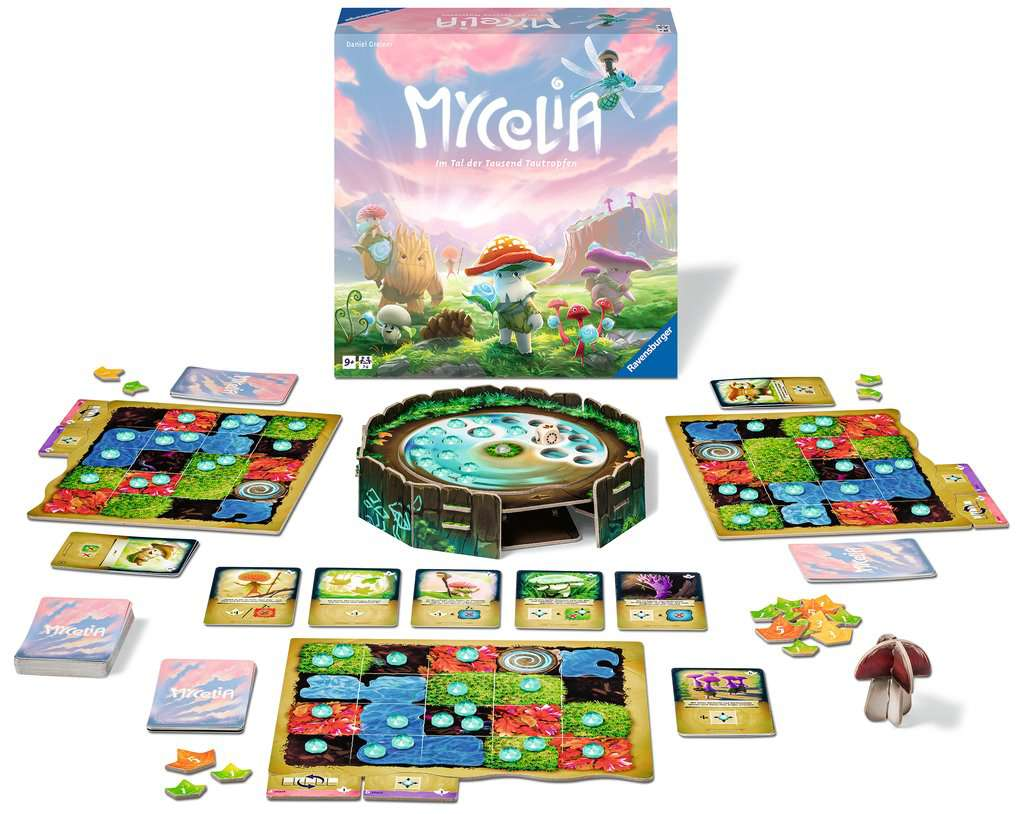
Mycelia (Ravensburger)
It should give you some idea of how vast the board game world has become when you hear that, in 2023 and 2024, two different mushroom-themed games called Mycelia hit the market from two different publishers. The one I played features a very fun mechanism at its core: The Shrine of Life, a round-ish platform that gets filled with dewdrops as the game progresses. When a set number is reached, its central circle is turned and a game-influencing die is dispensed underneath. The game itself is played out on double-sided game boards where these dewdrops begin their journeys. On your turn you can take basic actions, play movement and removal cards from your starter deck, or buy addition cards to build that deck into a more powerful one, with the goal being to move the dewdrops to the shrine on your board. It’s attractively presented if relatively simple, with little player interaction, which in this case diminished my desire a bit for repeat play.
Diced Veggies (KTBG)

Simple set collection is on the menu for this clever cleaver-ed game.
Players pour a pile of dice into a frame, remove the frame, and then take turns taking a slice (with a cardboard cleaver) in order to acquire needed dice, which are color coded to match the ingredients needed on recipe cards. Cutting rules include only taking dice that total ten or less, cutting only from a side, etc. Recipes can be enhanced by bonus cards for, say, only using even numbers or completing a recipe with no leftover dice. Its easy set up and simple to grasp rules, coupled with actual choices to be made, make this one a brisk appetizer for game night.

Ready Set Bet (AEG)
There are other terrific racing-themed board games on the market, but I haven’t found one that matches the high-energy of this one. That’s because, unlike at the actual racetrack, bets are placed here during the race. And that race is happening in real time thanks to either an app or the rolling-and-announcing from the most high-energy person in your group. Dice are rolled to determine which of the ten horses progress (2/3 and 11/12 move ahead when either numbers come up). Roll the same number twice and that numbered horse may advance quicker. As the horses shuffle for position, players throw down bets of various amounts, but only one bet can be placed on a particular betting square. Each square has a multiplier with some also having costs if the horse doesn’t win, place or show in the proper spot. Once three horses pass a certain line, no more bets can be placed. Once one horse crosses the finish line, bets are paid off, debts collected, and the horses reset for another race. Up to nine players can get a piece of the action and the more you have at the table, the more likely you are to hear your crew cheering on horses as the dice roll. There is some variability with prop bets, VIP cards, and Exotic Bet additions but the core of this is just fast, fun betting for those who like the pressure of horse racing without the risk of actually losing money (although, Shhh, I have come up with a real-money varient that I hope to try with the right group of friends some day).
Aqua (The Op Games)

In Aqua, you are start with an underwater hot spot , build coral formations, grow small marine animals and, if you play your tiles right, attract larger marine animals. Sometimes, alas, the design of a game and its scoring system gets in the way. Such is the case with this one, which has an honest, worthy theme (biodiversity in the oceans) and attractive tiles but too-busy set-up, and wonky scoring diminishes its potential pleasures. For a similar but better structured nature-based game, take a look at Cascadia from AEG.

Barcelona (Board & Dice)
Here’s a game where deep-dive thematics may push away all but those with a passion for heavy games. But the fully committed may find satisfaction. It’s set in what was once the most densely populated city in Europe but is now ready for expansion. You build streets, add tram lines, decide on public amenities, and try to attract citizens. Buildings have multiple levels, citizen are divided into working-, middle-, and upper-class, and there are lots of confusing tile choices, which means flipping back to the rule book perhaps a few too many times. Gamers often use the term “point salad” and this one is quintessentially that — one in with there are many, many ways to score points, all of which are added up at the end. Make sure to have at least one person at the table well versed in the rules before committing your crew.
The Alpha (Bicycle)

I’ll end this entry on some positivity. In The Alpha, players are wolf packs and, in turn, each chooses which prey to try to take down. When all wolves have been played, the pack with the majority on each prey scores that food. That jockeying for superiority is just part of the game. There’s a chance that the prey will escape — and that differs from beast to beast depending the roll of the unique dice for each. If it doesn’t, then the food goes to the dominate pack. What happens when two packs are equal? Then it turns into a version of the prisoner’s dilemma with negotiation, possible bluffing, and a secret choice. Will you share the food or fight for it? If all equal packs share, they divide the food points. If one fights and one shares, the fighter gets all of it. But if all opt to fight, all get injured and those wolves can’t be played in the next round — and the food goes to any other wolves that were on the space. The rules here are easy to grasp, the turns move quickly, the graphics and iconography clear, and the game play dramatic. And it was bargain basement-ing on Amazon.com for under $10.
Happy gaming.
 louharry.com