
Each fall, as an organizer of the American Theater Critics Association’s annual conference, I spend a few blissful, exhausting (is that a contradiction?) days in New York City with a few dozen arts journalits from around the country.
This time, that included hosting a discussion with the new leadership at famed improv/sketch company Upright Citizens Brigade, touring the new Perelman Performing Arts Center and hosting a chat with its artistic director, and running a challenging session of theatrical pub trivia. (Sample question: Put these musicals in geographical order from west to east based on their each’s primary location: “The Prom,” “Promises Promises,” “Paint Your Wagon,” “Plain and Fancy.”)
In addition, I sat in on sessions with theater legend Charles Busch, actors from the current revivals of “Sweeney Todd” and “Merrily We Roll Along,” the creative crew from the revisal of “I Can Get It For You Wholesale,” and more.
Of course, I also squeezed in as many shows as possible, both on- and off-Broadway.
Some thoughts:
Here Lies Love. For spectacle, there’s nothing quite like “Here Lies Love,” the musical by David Byrne and Fatboy Slim.
For this immersive party of a production, the seats in the Broadway Theatre’s orchestra section were removed and replaced with a dance floor. A mobile, cross-shaped stage kept the on-their-feet audience on their toes. And video screens, smaller stages and an open deejay booth in the balcony seemed desgned to leave no corner of the theater passive, even for those who opted for actual seats.

A dance-fueled glide through the rise and fall of Imelda Marcos, “Here Lies Love” has earned praise for putting an all-Filipino cast on stage. It has also taken heat for having a primarily white creative team tell that story. (The fall issue of the recently revived American Theatre magazine goes into detail in its smartly titled feature “The Complicated Triumph of ‘Here Lies Love’.”)
There has also been criticism that the show softens Imelda Marcos. While I do believe the show is deliberately structured to get the audience on her side early (And Arielle Jacobs’ performance in the role certainly feeds that), I think that’s part of what helps the show work. Perhaps its just me, but I found something slyly subversive going on in the way “Here Lies Love” offers fragments of biography combined with infectuous dance music to get the audience on the side of its leading lady, the way it takes her husband through the excited crowd followed by a broadcasting camera as his political stature rises, and the way it seemlessly leads audience members into switching parties and sympathies when rival Nino Aquino takes the stage.
In a sense, the gleeful audience members become stand-ins for a public willing to follow whatever leader holds the stage. For some, “Here Lies Love” is a dance party. For me, from the balcony, it was a fascinating look at how savvy politicians can sway a crowd.
Harmony. When I told my brother and sister-in-law, infrequent theatergoers, that I was seeing a musical with music by Barry Manilow, their ears perked up. When I told them it was an original score, not a collection of Manilow hits, their ears resumed their normal positions.
That could be the biggest marketing problem facing “Harmony,” which recently opened at the Ethel Barrymore Theatre
Unlike “Mamma Mia!,” “Jersey Boys,” “Beautiful,” and their lessers, “Harmony” isn’t a jukebox musical stringing together existing songs from a hitmaker’s catalog. Far from it. Instead, it’s the fact-anchored story of the Comedian Harmonists, a hot-hot-hot boy band from Germany that was all the rage prior to World War II and then, well, you don’t have to be a history buff to have an idea of where this is going, especially when you learn that some of the members were Jewish.
Previous versions were staged regionally as far back as 1997, but this production marks its first Broadway stint.
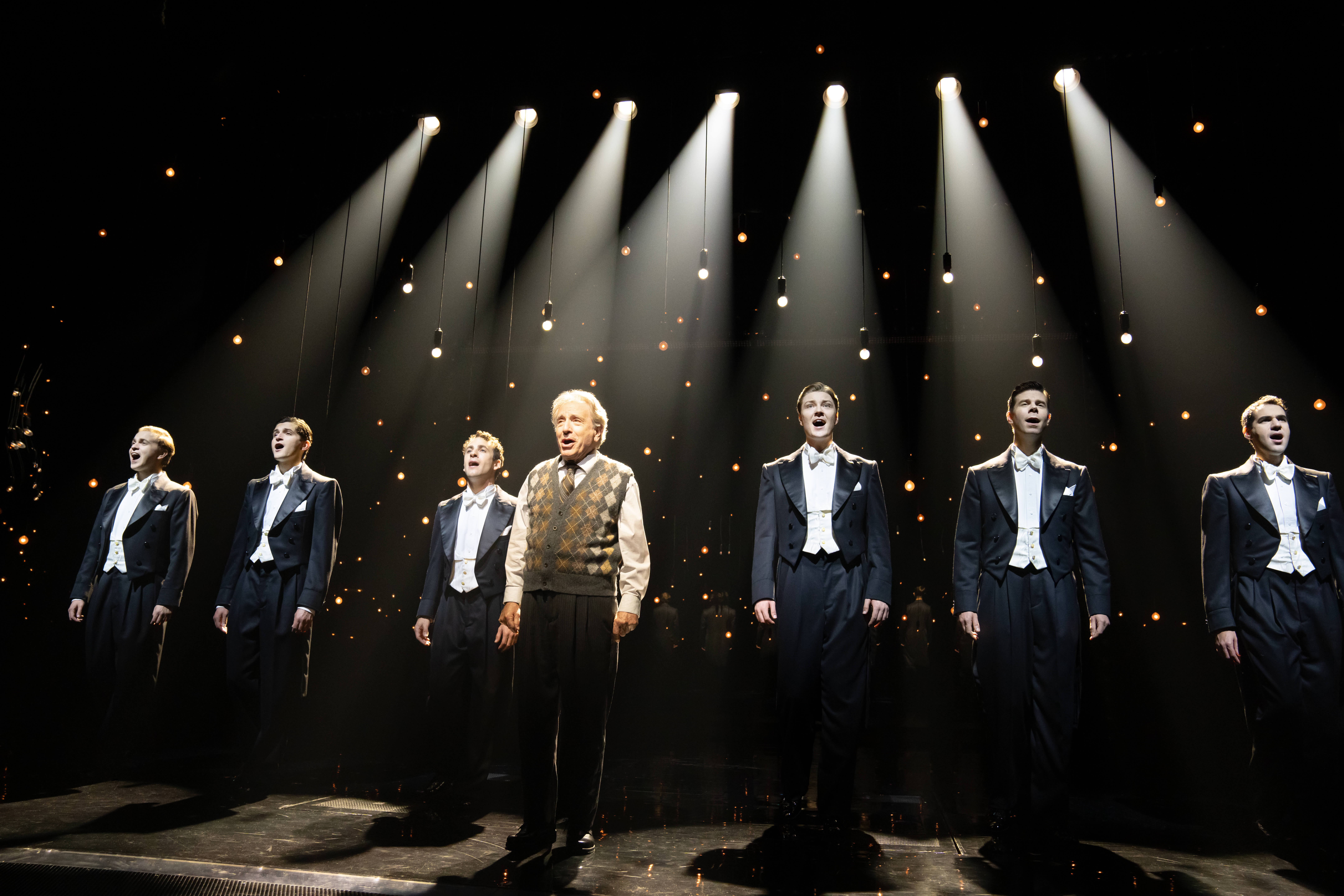
Unlike earlier productions, it’s now framed as a memory play, with the group’s last surviving member, nicknamed Rabbi (Chip Zien), telling, sometimes entering, and even stopping and correcting, the story. Zien, remembered fondly by musical theater fans as the original Baker in “Into the Woods” and Mendel in “Falsettos,” has a personality that pops. And his regrets give the climax of the show added gravitas.
But there’s not much room left to develop the bandmates or their partners. They sound great, but they are each primarily reduced to a single trait. The result, while entertaining, well sung, and a bit informative, still left me wondering if the story wasn’t better served by the documentary film on the same subject.
“Watch Night.” The first commissioned piece at the new Perelman Performing Arts Center at the World Trade Center site, “Watch Night” was the show I was most interested in seeing on this trip. It was also the one I knew least about. The primarily draw for me was that it was co-conceived, directed, and choreographed by Bill T. Jones, who in addition to his storied career leading the Bill T. Jones Arnie Zane Company, also picked up a deserved Tony Award for choreographing “Spring Awakening.” (He scored another one for “FELA!”).
A mix of dance, opera, spoken word poetry, narrative drama, and civics debate, “Watch Night” was a bold choice to help launch this dynamic, very flexible space. It’s impossible to separate what’s on stage from what happened on this site on September 11, 2001, and the creators of the piece clearly and boldly wrestle with issues of faith, forgiveness and repentance in the wake of mass trauma.

While 9/11 cast a shadow, it’s a church attack that provides the driving incidents in the piece. Its lead is a journalist (a compelling Brandon Michael Nase) with a Black father and a white Jewish mother. A copycast attacker strikes the synagogue of his brother, Saul (Arri Lawton Simon), a survivor of the church attack (Danyel Fulton) has a too too-coincidental job as a guard at the prison where the church killer (Kevin Csolak) awaits his death, and we get conflicting thoughts from the murderer’s school teacher (Jill Paice).
There’s plenty of plot here — perhaps too much. At least, too much that is presented via dialogue and lyrics. Sometimes, the words are poetic and powerful, well worth the repetition. (“Jesus died in the Blackest way possible / With his hands up / At the hands of the state”). Other times, though, I yearned for more to be expressed through movement, wanting to feel rather than be told. “Watch Night” is packed with talent and power. It just didn’t feel like it had found its ideal form yet.
And, for me, that’s okay. I’m hoping that the Perelman continues to take chances on commissions with artists willing to explore rather than cater. There’s enough formulaic work out there and I’d often rather see ambitious work that doesn’t reach its goals rather than projects that aim low and deliver.
Side note: The Perelman also has a public stage in its lobby where it will be presenting free events throughout the week. And the building itself is magnificent. I recommend checking it out even if you aren’t catching a mainstage show.
I Can Get It for You Wholesale. Known primarily now as the show that launched Barbra Streisand’s career, “I Can Get It for You Wholesale” had a 300 performance run in 1962 but, in spite of a cast album, hasn’t had much of an afterlife.

Convention wisdom is that the plot was too much of a downer. It concerns Harry Bogen, a guy who will do anything to succeed in the garment business. In the process, he disappoints his family, alienates his friends, and runs afoul of the law.
We’re used to downer stories now, even in musicals. But keep in mind that the much lighter story of another go-getter, “How to Succeed in Business Without Really Trying,” had opened just a few months earlier on Broadway. That one had more laughs, spritelier tunes and a film version to back it up. Plus, Robert Morse was a natural fit for musicals. Elliot Gould, the lead in “Wholesale,” wasn’t.
And so “Wholesale” languished.
The folks at Classic Stage Company, a leading off-Broadway theater housed in an intimate space on 13th Street, hope to change that. They’re currently attracting audiences with a production featuring a revised book by John Weidman, son of the show’s original book writer and novelist, Jerome Weidman.
It’s got a new opening to give the main character context, a new ending that toughens the piece, and a tweaked the song stack, pulling in some Harold Rome songs cut from the original. Plus the cast is packed with talent, led by Santino Fontana (Tony-winner for “Tootsie”), Judy Kuhn (“Chess,” “Fun Home”), and Rebecca Naomi Jones (the recent revival of “Oklahoma!”). As Miss Marmelstein (aka the Streisand part) the production team had the wisdom to snag Julia Lester (Little Red Riding Hood from the “Into the Woods” revival).
The result is a strong, satisfying production that doesn’t quite make the case for the show to be on the stage musical all-star team. It’s now got a more compelling, more nuanced story with richer characters, but the score — even heightened by David Chase’s adaptation and arrangements — remains only fair.
Still, it’s a good-enough musical given a terrific production.
Side note: The new ending did give me flashbacks to another vanished musical, Alan Menken’s pre-Disney “The Apprenticeship of Duddy Kravitz.” Like “Wholesale,” it concerned a stop-at-nothing character who finds himself isolated in the end. I still remember moments from its disappointing 1987 production in Philadelphia. I wonder if moments from the far superior “Wholesale” will linger in my memory as long as the ending of “Duddy.”
Waiting for Godot. Theater lovers can be snobby, throwing around “I can’t believe you’ve never seen __________” as if there’s universal access to the entire theatrical canon. But one’s experience as a theater audience members depends on a load of factors outside of one’s control, which is why I avoid belittling anyone who hasn’t seen a particular show. There’s a first-time “Hamlet” for everyone.
All of which is to say that, after a long lifetime of theatergoing, I’ve just experienced my first “Waiting for Godot” and I ask that you not judge me too harshly. Oh, I’ve read it and read about it, but I never spent quality time in the room with Estragon and Vladimir on their road to nowhere.
It is that time and proximity that makes the work so moving and so surprisingly funny in Brooklyn’s Theatre for a New Audience production.

Estragon (Michael Shannon) is already onstage when audiences enter the theater. And in those pre-show minutes when I would otherwise be doing a last-minute cell phone check, reading program bios, or chatting with my companion, I had trouble taking my eyes off him. Well before Samuel Beckett’s words were spoken, Shannon had brought world-weary life to Estragon, baffled and grim but not giving up. Once the play proper began, his grounding provided a strong counterpoint to Paul Sparks more animated Vladimir.
Even those of us who hadn’t seen previous productions know where this is going — or, more accurately in the case of “Godot,” not going. But it’s the road that matters. And, in this case, that road is paved with detailed performances, expert timing, and solid support. Unlike some other revivals of works considered modern classics that I’ve seen, this one never felt like an acting exercise. Director Arin Arbus and the company understand that absurd doesn’t have to translate into distancing. I felt more for the two men in this absurd situation — their ache and their sad strength — than I have for dozens of characters in more realistic plays.
And it’s good, on first viewing, to understand why a show is worthy of being called a classic.
Stereophonic. Why bury the lead? I loved this play and loved this production at Playwrights Horizons even more.
In a recording studio in 1976 (on a so-right set by David Zinn), a band is in the process of recording its second album. Its first disc has proven to be a hit, spawning chart-topping singles, and now the pressure has heightened for the band’s sophomore effort. Rifts, romances, and power struggles work their way into the mix, along with a bag of cocaine and a recording engineer with a fictional resume.
Penned by David Adjmi and directed by Daniel Aukin, “Stereophonic” doesn’t have an obvious agenda or a specific message to teach. It isn’t frivilous or familiar. It trusts its audience and relishes both intense dramatic outbursts and rich silences. It’s funny, it’s moving, and it’s peopled with seven distinct characters, who, in any combination, held me. This is a textbook example of what an ensemble cast can and should be. I never doubted for a second that these characters lived together, knew each other intimately, and were, in fact, outstanding musicians struggling to get this next album right even as their personalities, egos, and self-doubt kept getting in the way.
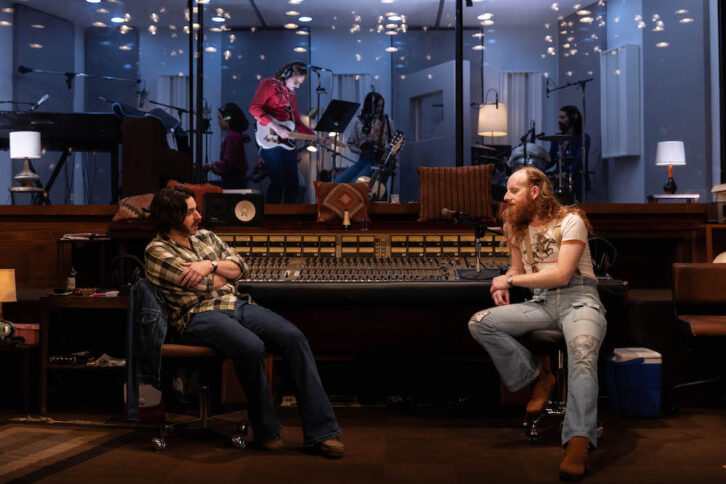
And I never doubted that the songs, by Will Butler (of Arcade Fire) were songs from the period. Not pastiche. Not parody. Just solid songs that would have comfortably emerged on my AM dial and kept me from changing the station.
I won’t go into the characters and their relationships to each other. That would take paragraphs and wouldn’t do justice to the layered glances, physicality and verbal interactions that make this play so rich. Suffice it to say that these actors — Will Brill, Andrew R. Butler, Juliana Canfield, Eli Gelb, Tom Pecinka, Sarah Pidgeon, and Chris Stack — live in these roles. And that Adjmi’s script gives them room to breath while gracefully guiding them.
Thanks to everyone involved — including sound designers, producers, and those who nurtured the development of the play — for creating the most satisfying new play I’ve seen in years. Here’s hoping for a long-playing life.
 louharry.com